Short answer
A dress pack for a welding robot has to withstand weld spatter, radiant heat and fast movements. Choose a protective hose based on movement and environment, add a layer of heat protection where the heat is greatest and manage the length with a retraction system, so the package does not hang in the spatter zone.
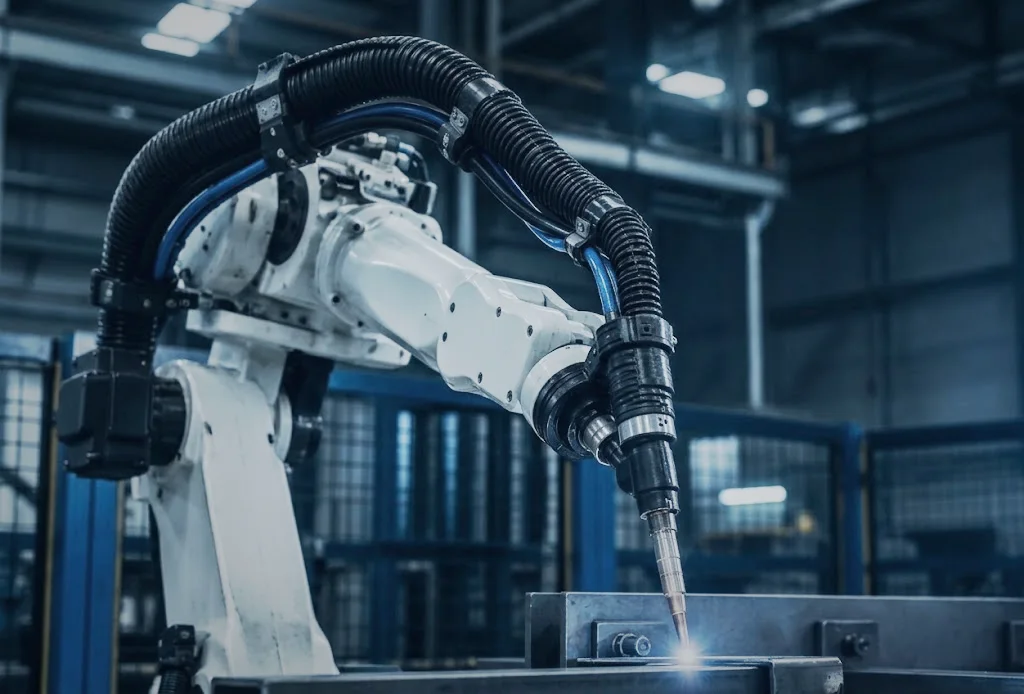
A dress pack for a welding robot has more to endure than a package on a handling robot. Weld spatter, radiant heat and fast movements around the wrist come together, and the hose package to the welding torch carries welding current, gas, cooling water and signal at once. So choose a protective hose that can withstand the environment, a layer of heat protection where the heat is greatest and a retraction system that keeps the package out of the spatter zone.
What makes a welding robot hard on the hose package?
When welding, four loads act on the package at once.
- Weld spatter and sparks. Hot particles land on the hose, especially at the torch and on the underside of the upper arm. A hose that is not resistant to this is damaged.
- Radiant heat. The welding process and hot workpieces radiate heat. That ages cable sheaths and hoses.
- Fast movements. A welding robot often changes position quickly between weld seams. The wrist rotates a lot, with torsion and tight bends.
- A heavy bundle. Welding current, gas, cooling water and signal run together to the torch. That is a thick, relatively stiff bundle that still has to follow every movement.
Where cables on a robot break in general and how that happens is explained in preventing cable breakage on your robot. Here we look at what welding adds on top.
What runs through the dress pack of a welding robot?
Everything the welding torch needs goes along the arm to axis 6. At the end fitting the hose arrives at the torch. A typical content:
- (01)Welding current, in a cable with a large cross-section
- (02)Shielding gas, in a hose
- (03)Cooling water, flow and return, with water-cooled torches
- (04)Wire feed, in processes with welding wire
- (05)Signal and data, for sensors and control
Each of those cables and hoses must be able to handle the movement. Choose cables made for continuous movement; more on that in which cables belong in a cable carrier. Gas and water hoses swell under pressure, so when determining the hose size allow more clearance than for cables alone.
Measure the bundle at its thickest point, including any connectors that have to pass through during installation. That size determines the protective hose, and with it which clamps and which retraction system fit. How to choose that size precisely is covered in choosing a dress pack for your robot.
Which protective hose do you choose for a welding robot?
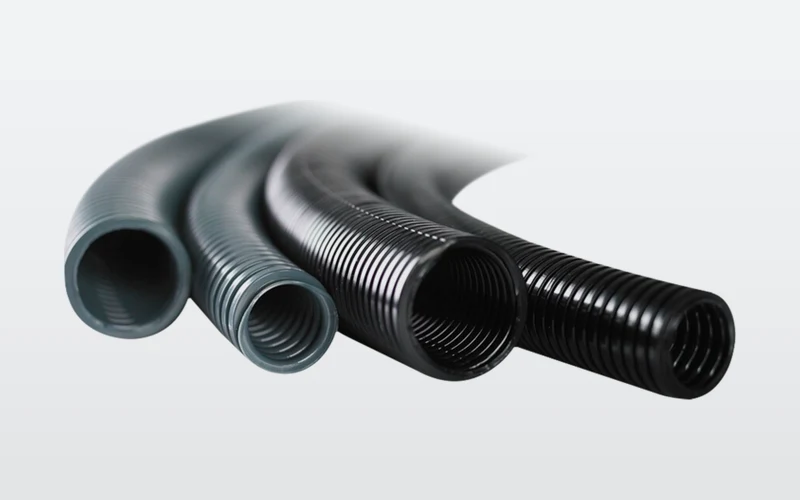
Movement and environment determine the series. Reiku classifies the robot hoses by application. For a cable package on an industrial robot with normal dynamics there are PARAB, PARRB and BIORRB. For very heavy dynamics, with a lot of torsion and fast movements, there are PURRB and the reinforced PURVB. If static charge has to be discharged, there is the conductive LPRRB.
With a welding robot, two questions therefore come into play:
- How heavy is the movement around the wrist? A lot of torsion and fast changes point to a more flexible series.
- What lands on the hose? Spatter and heat determine whether an extra layer is needed around the hose, and where.
The catalogue does not give a single rule for which series withstands how much spatter. That is why we choose the hose based on the process and its position in the cell, and combine it with heat protection where needed. Tell us the welding process and how close the package gets to the weld, and we will advise on the version. All series are on the protective hoses for robots page.
Which heat protection suits welding?
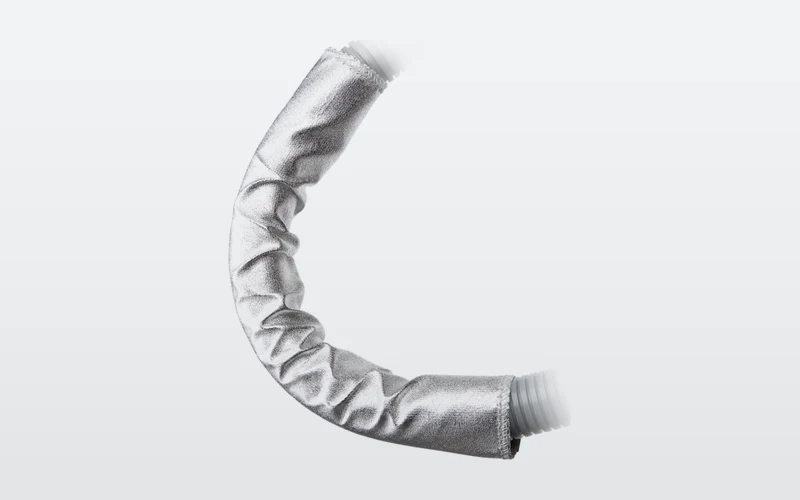
Where the heat is greatest, a layer of heat protection goes around the hose. Reiku supplies three materials based on glass, silica and aramid fabric with an aluminium layer that reflects radiant heat:
| Material | Radiant heat up to | Fabric | Special feature |
|---|---|---|---|
| GLASO | +350 °C | Glass fabric with aluminium | Reflects up to 90% |
| GLASIL | +650 °C | Silica fabric with aluminium | Asbestos-free, acid-resistant |
| KEVLAR® | +800 °C | Para-aramid with aluminium foil | Reflects up to 95% |
Note what those limits mean. They apply to radiant heat. For weld spatter, sparks and direct contact with hot parts, the catalogue gives no limit. The sleeves reduce damage from spatter and sparks, but how far that gets you depends on the process. That is why we assess those situations personally. With heavy spatter we combine the heat protection with an extra protective hose.
There are two forms:
- Split sleeves that you close around the package afterwards, without disconnecting the cables
- Strips for wrapping, in widths from 25 to 300 mm
You do not have to wrap the whole package. Often protection is only needed on the section that lies in the spatter zone or close to the heat source, such as at the torch and the wrist. All sizes per material are on the heat protection page.
Calculate it yourselfHeat guideThe right heat protection for cables and hosesOpen the heat finderThe Heat Guide asks for temperature, bundle diameter and requirements such as cut resistance or resistance to acids. You also indicate whether there is weld spatter. You get the lightest material that is sufficient, in the smallest suitable size, and with weld spatter a note that we will look at it personally.
Why is a retraction system so important on a welding robot?
A loop hanging beside the arm is doubly troublesome in welding. It strikes the cell, the fixture or the workpiece, and it often hangs exactly in the zone where the spatter lands. The longer the hose lies there, the more it has to endure.
A retraction system on the upper arm pulls excess hose back when the robot retracts, and releases it when the robot extends. The retracted hose lies behind the robot, outside the working area. There are three versions: fixed guide, tilting and a ball type with ±12° movement in the clamp. A lot of up-and-down arm movement calls for a tilting version or the ball type. We choose the spring based on hose size and arm length.
At the wrist, a ball joint lets the hose move at an angle. That absorbs part of the torsion a welding robot generates when switching between seams.
How do you keep a welding robot's dress pack in good condition?
A welding environment calls for more frequent checks than a clean handling cell. During planned stops, look at:
- Spatter residue on the hose and the heat protection, especially at the torch
- Damaged spots in the protective hose or the reflective layer
- Clamps that start to shift or clamping jaws that wear
- The retraction system: does it still spring back properly?
- A loop that still enters the spatter zone when extending
- Faults in welding current or signal that only occur in certain positions
Hose, clamps, clamping jaws, springs, wear parts and heat protection are available separately. So you replace a damaged section without renewing the whole package. Heat protection in strips can be wrapped around an existing bundle without disconnecting the cables.
If you work with several welding robots of the same type, use the same package for each type. Then you know which parts you need in stock.
Assembling a dress pack for your welding robot
In the dress pack configurator you choose the make, model and build of your robot and assemble the hose, holders and fixing for each axis. For welding robots, heat protection is switched on by default. You get a parts list with article numbers that our robot division checks.
We feed the cables and hoses in at our workshop in Ruurlo and install the dress pack on site in the Netherlands and Belgium, during a planned stop. Send us the robot model, welding process and what goes to the torch, and we will propose a package. You can do that via a quote request for your dress pack.
Calculate it yourselfDress pack configuratorConfigure a dress pack for your robotOpen the dress pack configuratorFrequently asked questions
Is a protective hose resistant to weld spatter?
That depends on the series and the process. For welding we choose the hose based on the environment and combine it with heat protection where needed. Tell us the process and we will advise on the version.
Up to what temperature does the heat protection protect?
GLASO up to +350 °C, GLASIL up to +650 °C and KEVLAR® up to +800 °C radiant heat. For weld spatter and contact with hot parts the catalogue gives no limit; we assess those situations personally.
Can I fit heat protection around my dress pack afterwards?
Yes. There are split sleeves that you close around the package and strips for wrapping, without disconnecting the cables.
Does the whole hose package of the welding robot need heat protection?
Usually not. Protection is mainly needed on the section in the spatter zone or close to the heat source, such as at the torch and the wrist.
Why is there a loop in the cell with my welding robot?
The package needs more length when extended than when retracted. Without a retraction system, that difference hangs as a loop beside the arm. A retraction system on the upper arm pulls that hose back.
Next step
Calculate it yourself or browse the range. We check your result free of charge.
Question about this topic?
Ask Daan directly
Robotics Division at Wisman Techniek