Short answer
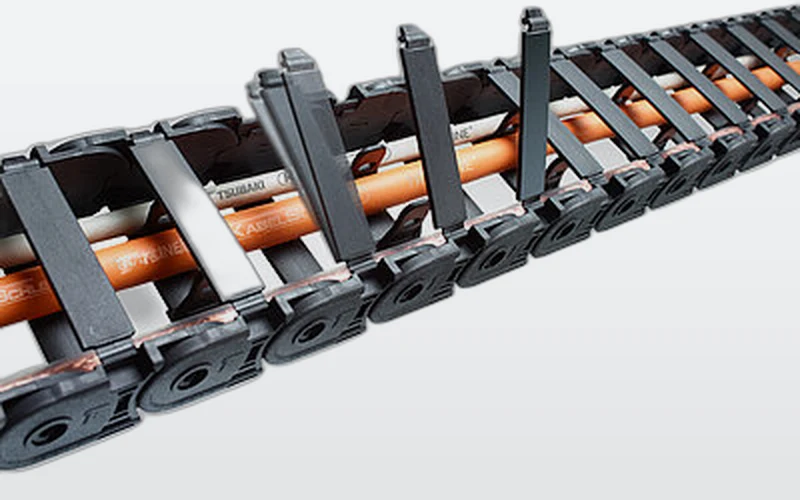
In a cable carrier, only use flexible cables designed for continuous movement, with finely stranded conductors, a special stranding and a wear-resistant sheath. Choose the class by travel length and number of movements, and the shielding by the signals you carry.
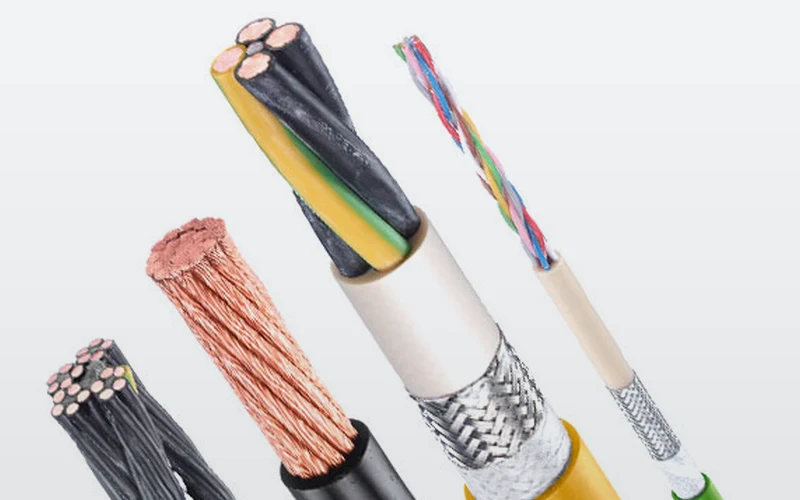
A cable carrier needs cables made to bend thousands to millions of times: finely stranded, with a special stranding and a wear-resistant sheath. A standard installation cable is made to be laid once. In a carrier it bends with every stroke, and it is not designed for that. The carrier protects the cable, but the cable itself has to cope with the bending.
Why does a standard cable break in a cable carrier?
With every movement the cable bends through the curve of the carrier. The outside of the cable is stretched, the inside compressed. In an installation cable with coarse conductors and a long lay length, the wires therefore break over time. Often this happens invisibly, inside the sheath.
You may recognise the result: intermittent signals, a motor that drops out now and then, or a cable that keeps failing in the same spot. The troubleshooting guide explains how to recognise cable breakage in the cable carrier and what causes it.
How do you recognise a cable for a cable carrier?
A cable for moving applications has a few clear characteristics. Look in the datasheet for:
- Finely stranded conductors, which better withstand repeated bending
- The core construction: bundle stranded, layer stranded or twisted pairs, with a short lay length so that tension and compression in the bend are absorbed
- A wear-resistant, low-friction sheath of PVC, PUR or TPE
- A minimum bending radius for moving applications and a specified number of motion cycles
- The maximum travel length the cable is intended for
If the datasheet gives no bending radius for moving applications, the cable is not made for a cable carrier.
Which cable class do you need?
With the TRAXLINE cables from Tsubaki Kabelschlepp the class is in the name: 200, 400, 700 or 1000. The higher the number, the more demanding the application the cable can handle. For the control cables these are the manufacturer's figures:
| Class | Example | Sheath | Motion cycles up to | Travel length up to |
|---|---|---|---|---|
| 200 Basic | CONTROL 200 | PVC | 2 million | 25 m |
| 400 Demanding | CONTROL 400 600V | PVC | 4 million | 100 m |
| 700 Highly demanding | CONTROL 700 600V | PUR | 7 million | 500 m |
| 1000 Extreme | CONTROL 1000 TPE 300/500V | TPE | 10 million | 1000 m |
The 200 class is bending flexible and intended for short strokes and simple bending applications. From 400 upwards the cables are high-flex, and the control cables are then bundle stranded. For daily movement over long travel lengths, choose 700 or 1000.
Do not automatically pick the heaviest class. The lightest class that can handle your travel length and number of movements is usually the most sensible choice. The cable finder works exactly that way: you enter type, cores, cross-section, shielding, travel length and cycles, and the lightest class that is sufficient appears at the top.
Calculate it yourselfCable finderThe right flexible cable for your cable carrierOpen the cable finderWhich types of cable go in a cable carrier?
A carrier often holds different cables and hoses side by side. In our range of flexible cables you will find these types:
- (01)Control cables for sensors, valves and operation, such as the CONTROL 700 C 600V
- (02)Power cables for motors and drives, multi-core or single-core (POWER ONE) for large cross-sections
- (03)Data cables with twisted pairs for encoders, resolvers and measurement signals
- (04)BUS and network cables such as PROFIBUS, PROFINET, CAN bus, USB, CAT.5e/6 and coax
- (05)Fibre-optic cables such as the FOC 700, immune to electromagnetic interference
- (06)High-voltage cables for cranes and heavy installations with long travel lengths
- (07)System cables that combine power and signal in one sheath
Hoses for pneumatics, hydraulics or coolant often run alongside. They need more clearance than cables, because they swell under pressure.
Shielded or unshielded?
Power cables and signal cables in the same carrier can interfere with each other. A motor cable to a frequency converter emits interference, while an encoder cable is sensitive to it. The TRAXLINE series are available unshielded, shielded and double shielded.
- Use shielded power cables for servo and controlled motors
- Use shielded data cables with twisted pairs for encoders and measurement signals
- Separate power and signal in the carrier with a divider
- Consider fibre optics for long travel lengths and a lot of interference in the environment
How to distribute the cables in the carrier is explained in laying out a cable carrier with dividers.
How do you determine inner height and bending radius for your cable?
The thickest cable determines two dimensions of the carrier: the inner height and the bending radius. On the site we calculate as follows:
- Inner height: at least the cable diameter × 1.1 (10% clearance)
- Bending radius: at least the cable diameter × 7.5, generous × 10 for many movements
- If the datasheet gives a larger minimum bending radius, that applies
An example with the POWER 700 C 1kV 4G4 (13.8 mm). The inner height must be at least 13.8 × 1.1 = 15.2 mm, so 16 mm. The bending radius at least 13.8 × 7.5 = 104 mm, generous 138 mm. With a UNIFLEX Advanced or M series you then choose the first available radius above that. More explanation in determining the right bending radius.
Calculate it yourselfCalculate the bending radiusMinimum bending radius from your thickest cableCalculate itHave cables supplied ready-fitted in the carrier
Many cable faults do not arise in the cable itself but at the connection. A cable that is not properly secured at the fixed point or the driver breaks exactly there. So make sure there is good strain relief at both ends.
On request we supply carriers complete: cut to length, filled with your cables and with the end connectors fitted. We assemble the carrier to size in Ruurlo. In the cable carrier configurator you choose a TRAXLINE cable from the range directly in the cable package step, and in your request you indicate whether we should supply the cables with it.
Replacing a broken cable in an existing carrier? Then choose a cable made for moving applications straight away, otherwise the problem will recur. You can also send a cable list through a quote request.
Frequently asked questions
Can I use a standard installation cable in a cable carrier?
No. An installation cable is made for fixed installation, not for repeated bending. In a cable carrier the conductors break over time, often invisibly inside the sheath.
What is the difference between a PVC, PUR and TPE sheath?
In the TRAXLINE cables, PVC is used in the 200 and 400 classes, PUR in the 700 class and TPE in the 1000 class. The higher the class, the more motion cycles and the longer travel lengths the manufacturer specifies.
What does C or CD in a cable name mean?
In the TRAXLINE cables, C stands for a shielded cable. CD usually stands for double shielded; the exact shielding is shown on the cable's series page. Choose shielding for cables that emit interference, such as motor cables, or are sensitive to it, such as data and encoder cables.
How thick can a cable be in a cable carrier?
The cable diameter is at most the inner height of the carrier divided by 1.1. A carrier with 38 mm inner height therefore takes a cable up to about 34.5 mm. Also take the cable's minimum bending radius into account.
Can cables and hoses go together in one cable carrier?
Yes, that is very common. Separate them with a divider and calculate hoses with 20% clearance instead of 10%, because hoses change in diameter and length under pressure.
Next step
Calculate it yourself or browse the range. We check your result free of charge.
Series on this topic
Question about this topic?
Ask Bas directly
Cable Carriers Specialist at Wisman Techniek