Short answer
A flexible cable is only truly flexible if it is made for continuous movement: finely stranded conductors, a short lay length and a stated number of motion cycles and bending radius for moving use. A cable that merely feels supple is not yet suitable for a cable carrier.
A flexible cable is only truly flexible if the manufacturer has designed and tested it for continuous movement. Feeling supple is not enough. A cable you can easily bend by hand can break in a cable carrier after a short time. The difference is inside: in the conductors, the stranding and the jacket. And in the datasheet: if it gives no number of motion cycles and no bending radius for moving use, the cable is not intended for movement.
What is the difference between a fixed, bending-flexible and highly flexible cable?
Broadly, there are three types of cable, each for its own use.
- Cable for fixed installation: laid once and not moved again. Think of a cable in a cable tray or in a wall. The conductors are solid or coarsely stranded.
- Bending-flexible cable: may move or bend occasionally, for example with a short stroke or a device that is moved now and then. More finely stranded than an installation cable, but not made for daily movement over long distances.
- Highly flexible cable: made to move continuously, millions of times, in a cable carrier or on a machine that travels back and forth all day.
You see this classification in the TRAXLINE cables from Tsubaki Kabelschlepp. The 200 class is bending-flexible. From the 400 class upwards, all series are highly flexible. Which class suits your application is explained further on.
In practice the term "flexible cable" is used for all these types. That is why it pays to look beyond the name. If you request a bendable cable for a moving application, always state the travel length and how often the machine moves.
How do you recognise a truly flexible cable?
You recognise a cable for moving applications by four things.
Fine-stranded conductors
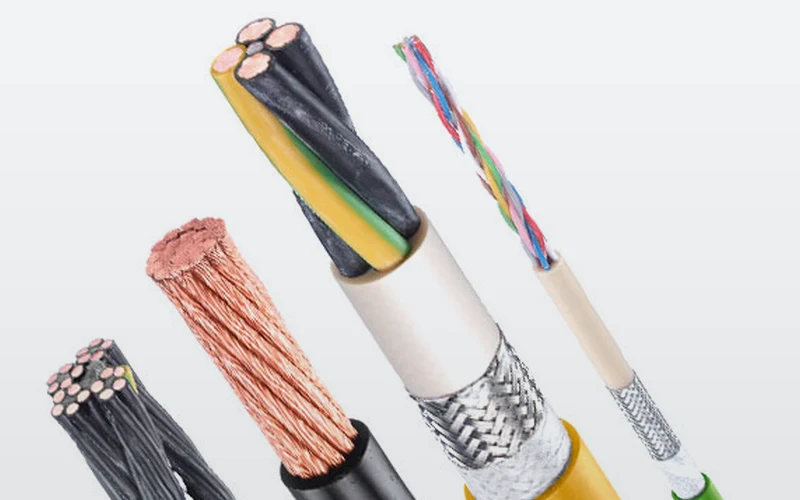
A conductor made of many thin wires bends more easily and fatigues less than a conductor made of a few thick wires. The IEC 60228 standard divides conductors into classes. Classes 1 and 2 are solid and stranded, for fixed installation. Class 5 is finely stranded and class 6 extra finely stranded, and these are what you find in cables that have to move. Fine stranding alone is not enough, though: even a finely stranded cable breaks if the construction is wrong.
A short lay length and the right construction
The cores are laid around each other in a spiral. With a short lay length, each core keeps alternating between the inside and outside of the bend. This spreads stretching and compression across all cores. In the TRAXLINE data you see these constructions:
| Assembly | Where you find it |
|---|---|
| Twisted in layers | CONTROL 200, DATA 400 C, DATA 700, FOC 700 |
| Twisted into bundles | CONTROL and POWER from the 400 class upwards |
| Twisted pairs | DATA 700 TPi, BUS cables such as PROFIBUS and CAN-BUS |
| Single | POWER ONE for large cross-sections |
| Hybrid | SYSTEM S and SYSTEM M, power and signal in one jacket |
Bundle stranded means the cores are first twisted into small bundles, and those bundles are then twisted around a core. This is the construction for multi-core cables that have to move a lot.
A wear-resistant, slip-resistant sleeve
In the carrier, the jacket rubs against the crossbars and against other cables. It has to be wear-resistant, slide well and withstand whatever is in the environment. With TRAXLINE these are PVC, PUR and TPE. Which jacket to choose when is covered in PUR or PVC cable in the cable carrier.
Stated cycles and bending radius for moving use
A truly flexible cable has a number of motion cycles, a maximum travel length and a minimum bending radius for moving use in its datasheet. If those are missing, nobody has tested how long the cable will last.
Bending or torsion: why does it matter?
In a cable carrier the cable bends in one plane. It goes through the bend, stretches on the outside and is compressed on the inside. That is bending, and that is what the TRAXLINE cables are made for.
On an industrial robot something different happens. Around the wrist, the cable also rotates around its own axis. That is called torsion, and it puts a different load on the conductors and the construction. A cable that handles bending well is not automatically suitable for torsion. If it concerns the cabling to a robot's tool, look at a dress pack and read choosing a dress pack for your robot. For the travel of a robot on a linear axis, you simply use a cable carrier with highly flexible cables again.
Which flexible cable suits your travel length and number of cycles?
With TRAXLINE the class is in the name. For control and power cables, the manufacturer states these limits:
| Class | Flexibility | Sheath | Motion cycles up to | Travel length up to |
|---|---|---|---|---|
| 200 Basic | Flexible in bending | PVC | 2 million | 25 m |
| 400 Demanding | Highly flexible | PVC | 4 million | 100 m |
| 700 Highly demanding | Highly flexible | PUR | 7 million | 500 m |
| 1000 Extreme | Highly flexible | TPE | 10 million | 1000 m |
Note: these are the limits for control and power cables. Data and bus cables have their own limits. The DATA 700 series go up to 200 m travel, the DATA 1000 TPi C TPE up to 400 m, and a USB S 700 C up to 5 m. So always check the series itself.
This is how you choose in three steps:
- (01)Determine the travel length of the machine, i.e. the distance the cable carrier covers.
- (02)Estimate the number of movements: how often per hour, how many hours per day, how many years. One movement back and forth is one cycle.
- (03)Choose the lightest class whose travel length and cycles are both above your values.
Choosing the heaviest class just to be safe is rarely necessary. A lighter class with ample margin is usually the better choice. If you are in doubt between two classes, choose the heavier one.
Very long travel lengths also need the right carrier. For those we use the TKHP. For most machines the UNIFLEX Advanced is the all-rounder.
What bending radius does a flexible cable need?
Even a highly flexible cable has a limit. On the site we calculate the bending radius of the carrier at a minimum of 7.5 times the cable diameter, and generously at 10 times for frequent movement. If the datasheet gives a larger minimum bending radius, that applies.
An example with a CONTROL 400 600V 7G1, with an outer diameter of 9.4 mm. Minimum 9.4 × 7.5 = 71 mm, generous 9.4 × 10 = 94 mm. For frequent movement you therefore choose a carrier with a radius of at least 94 mm. More explanation and the worked example for the inner height are in determining the right bending radius.
Calculate it yourselfCalculate the bending radiusMinimum bending radius from your thickest cableCalculate itHow do you quickly find the right flexible cable?
Do you know what has to go through the cable, but not which series? Then use the Cable finder. You choose the cable type, the number of cores and the cross-section, the shielding, the travel length and the number of cycles. The cable finder searches the TRAXLINE range and puts the lightest cable that will do at the top. For each cable you see the outer diameter and the minimum inner height of the carrier.
Calculate it yourselfCable finderThe right flexible cable for your cable carrierOpen the cable finderAlready know which cable you need, by article number or series? Add it with the number of metres to your request list. You will hear stock and price within 1 working day, including the copper surcharge of the day. We supply loose, cut to length or complete in the carrier. All series and variants can be found under flexible cables for the cable carrier.
Which types of cable go in a carrier, from control to fibre optic, is covered in which cables belong in a cable carrier. If a cable is already failing in an existing machine, first check cable breakage in the cable carrier for the cause. Otherwise, start with the Cable finder or send your cable list with a quotation request.
Frequently asked questions
What is a flexible cable?
A flexible cable has finely stranded conductors and a construction that lets it move without breaking. For a cable carrier you need a highly flexible cable, with a stated number of motion cycles, a maximum travel length and a bending radius for moving use.
What is the difference between bending-flexible and highly flexible?
A bending-flexible cable may move occasionally or make short strokes. A highly flexible cable is made for continuous movement over longer travel lengths. With TRAXLINE, the 200 class is bending-flexible and the 400, 700 and 1000 classes are highly flexible.
Is a supple cable also suitable for a cable carrier?
Not automatically. Suppleness says something about how easily you bend the cable, not about how often it can keep doing so. Check the datasheet for the number of motion cycles and the bending radius for moving use.
Can a flexible cable also handle torsion?
A cable for the cable carrier is made for bending in one plane. Torsion, such as around a robot's wrist, is a different load. For that, look at a dress pack and a cable intended for torsion.
Which class of flexible cable do I need?
Choose the lightest class whose travel length and motion cycles are above your values. For TRAXLINE control and power cables, that is the 200 class up to 25 m, the 400 up to 100 m, the 700 up to 500 m and the 1000 class up to 1000 m, provided the number of cycles also fits.
Next step
Calculate it yourself or browse the range. We check your result free of charge.
Series on this topic
Question about this topic?
Ask Bas directly
Cable Carriers Specialist at Wisman Techniek