Short answer
Choose a dress pack based on the robot model, the process and what has to go to the tool. The bundle diameter sets the hose size, the motion sets the hose series, and the robot decides whether you need a complete package over axes 1–6 or only the upper arm. For welding, heat protection is added.

You choose a good dress pack in four steps: the layout that suits your robot, the hose size that suits your cable bundle, the hose series that suits the motion and the extra protection your process calls for. Follow that order and you get a package that lies free in every robot position, without cable breaks at the wrist or loops that catch in the cell.
What is a dress pack and why does a robot need one?
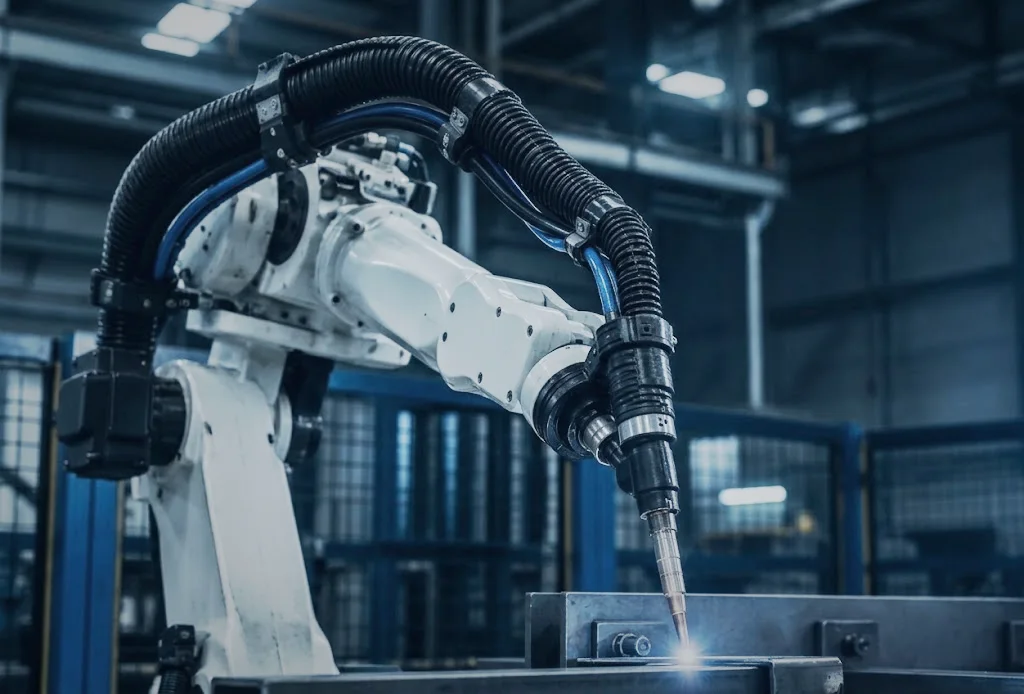
An industrial robot moves in six axes at once. Everything that goes to the tool, such as welding current, air, cooling water, signal and data, bends, rotates and twists with every movement. Without guidance the package rubs along the arm, catches in the cell and cables break at the wrist.
A dress pack solves this with three building blocks: a corrugated protective hose around the cables, holders that fix the hose per axis or let it move along, and a retraction system that pulls back excess hose when the robot retracts. See also the page on robot dress packs.
| Nr | Part | Where | What it does |
|---|---|---|---|
| 1 | Protective hose | As 1–6 | Absorbs rubbing, kinking and spatter |
| 2 | Rotary flange | As 1 | Lets the package rotate 360° with the base |
| 3 | Clamp | As 3 | Guides the hose on the upper arm, holds it or lets it slide |
| 4 | Retraction system | Upper arm | Pulls excess hose backwards |
| 5 | Ball joint | Wrist (axes 4 and 5) | Lets the hose move along at an angle |
| 6 | End fitting | As 6 | Connects the hose to the welding torch, gripper or spray head |
Complete, upper arm or base: which layout suits your robot?
Not every robot needs a package over all axes. We put together four layout variants:
- Complete dress pack, axes 1–6: from the base to the tool, with rotary flange, clamps, retraction system, ball joint and end fitting.
- Upper arm, axes 3–6: for robots where the cabling up to axis 3 is already routed well. Clamp with retraction system on the upper arm, ball joint at the wrist and fitting on axis 6.
- Base, axes 1–3: guidance from the base to the upper arm, to be extended with an upper arm package.
- Cobot package: a light hose with clamps along the segments and a fitting at the tool, without a retraction system. That keeps the arm free for collaboration.
The robot itself determines the class: compact, medium, heavy or cobot. We base the starting hose size on it: 36 mm for compact robots, 52 mm for the mid-range, 70 mm for heavy robots and 29 mm for cobots.
In the dress pack configurator you choose brand, model and layout. If your model is not listed, type it in yourself and choose the class. You get a parts list per axis.
Calculate it yourselfDress pack configuratorConfigure a dress pack for your robotOpen the dress pack configuratorWhat size of protective hose do you need?
The size follows from everything that has to go through the hose. Measure the cable bundle at its thickest point and choose the smallest hose whose inner diameter encloses that bundle. That is also how the hose selector on the protective hoses for robots page works.
A worked example: your bundle measures 33 mm at its thickest point. In the PARAB series the smallest black size that fits is the PARAB-36G, with an inner diameter of 35.9 mm. According to the catalogue, the minimum dynamic bending radius of that size is 180 mm. If the bundle only just fails to fit, or the hose has to pass over a connector, choose one size up.
Then check that the size matches the holders. Clamps come in fixed hose sizes from 17 to 90 mm, retraction systems from 17 to 70 mm. So the hose size determines which clamps and which retraction system you can use. That is why we always choose hose and holders together.
Which hose series do you choose: flexible, extremely flexible, form-stable or conductive?
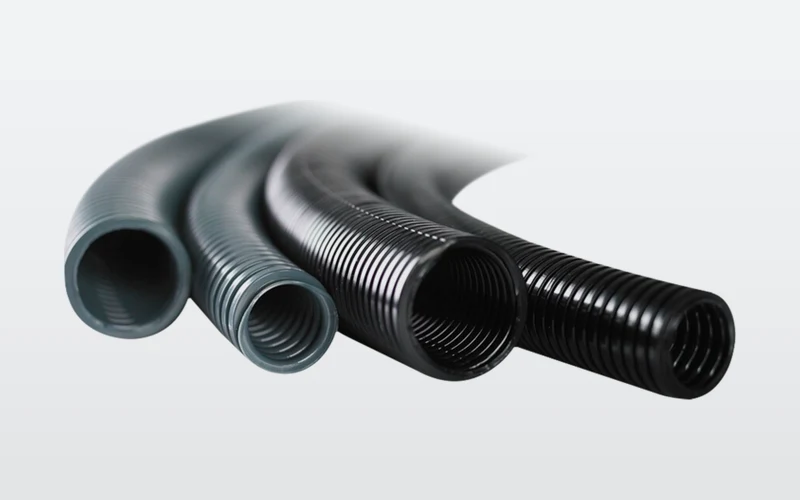
Motion and environment determine the series. These are the four series you choose in the configurator, with the data from the Reiku catalogue:
| Series | Material | Character | Dynamic use | When |
|---|---|---|---|---|
| PARAB | PA 12 | Flexible | -5 to +85 °C | The standard for most robot packages |
| PURRB | PUR | Extremely flexible | -20 to +90 °C | A lot of motion and torsion around the wrist |
| PARRB | PA 12 | Form-stable | -30 to +85 °C | More stiffness along the length |
| LPRRB | PA 12, conductive | Conductive | -5 to +85 °C | Where static charge has to be dissipated |
For very heavy dynamics there is a reinforced PUR version (PURVB), and with BIORRB a robot hose in PA 11 based on castor oil.
Holders and retraction system: where do you fix the hose?
A good hose without the right holders will still rub against the robot. The holders and fixings determine where the hose is fixed, where it may slide and where it may rotate. The system is modular: a clamp with interchangeable clamping jaws, with a nylon, metal or screw closure. Rotary flange, clamps, ball joint and end fitting sit on the axes shown in the table above.
When the robot extends, the package needs more length than when it retracts. A retraction system pulls that extra length back so no loop hangs beside the arm. There are three versions: fixed guidance in a clamp, tilting like a seesaw, and a ball shape that moves ±12° in the clamp. We choose the spring based on hose size and arm length.
Welding or heat at the tool: which heat protection?
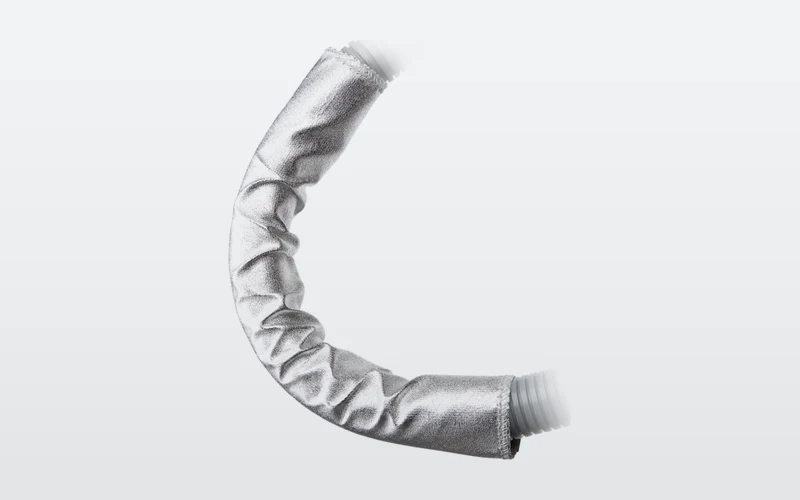
For welding robots and processes with radiant heat, a layer of heat protection goes around the hose. Reiku has three materials for this, rated for radiant heat: GLASO.A up to 350 °C, GLASIL.A up to 650 °C and KEVLAR® up to 800 °C. There are split sleeves you close around the package afterwards and strips for wrapping.
The temperature limits apply to radiant heat. For weld spatter, sparks or contact with hot parts the catalogue gives no limit, so we assess those situations personally. The heat protection page lists all sizes per material.
The heat guide asks for temperature, bundle diameter and requirements such as cut resistance or resistance to acids, and gives the lightest material that will do with the smallest fitting hose size.
Calculate it yourselfHeat guideThe right heat protection for cables and hosesOpen the heat finderRobot on a linear axis: dress pack and cable carrier together
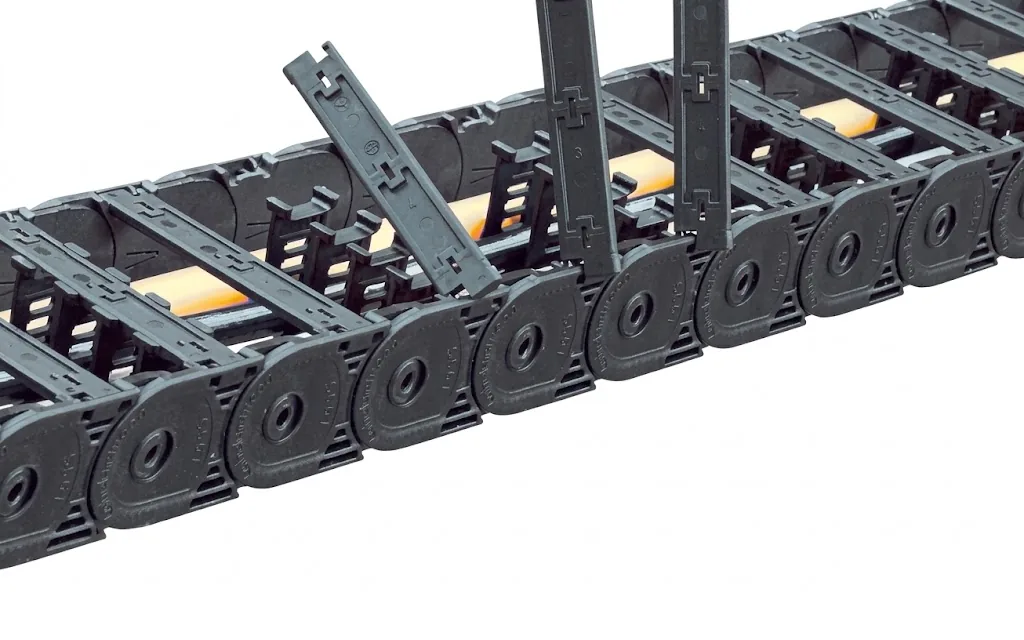
If the robot travels along a linear axis, the seventh axis, the energy supply over that travel goes through a cable carrier. The comparison cable carrier or protective hose explains where the line between the two lies. For that section, also choose cables suited to continuous motion; which cables belong in a cable carrier explains what to look for.
Replacing or maintaining an existing dress pack
Hose, clamps, wear parts and retraction system are available separately, so a worn dress pack does not always have to be replaced as a whole. Watch for the first signs: a hose rubbing along the arm, a clamp that starts to slip or a loop that brushes along the cell when the robot extends. Spotting wear in time explains how to see this early.
We feed the cables and hoses into the package in our workshop in Ruurlo and deliver the dress pack ready for mounting. In the Netherlands and Belgium our robot division handles assembly and installation. If you already know what you need, request a quote for your dress pack directly.
Frequently asked questions
What is a dress pack for a robot?
A dress pack is the complete package that protects and guides the cables and hoses to a robot's tool. It consists of a protective hose, holders per axis and usually a retraction system.
What size of protective hose do I need for my robot?
Measure the cable bundle at its thickest point and choose the smallest hose whose inner diameter encloses the bundle. Then check that clamps and retraction system exist in that size. As a starting point: 36 mm for compact robots, 52 mm for the mid-range, 70 mm for heavy robots and 29 mm for cobots.
What does a retraction system do on a robot?
The retraction system pulls excess hose backwards when the robot retracts and releases it when the robot extends. That way no loop hangs beside the arm to strike the cell, the workpiece or the robot itself.
Does a cobot need a dress pack?
A cobot also has cabling running to the tool. For that there is a light cobot package: a hose with clamps along the segments and a fitting at the tool, without a retraction system, so the arm stays free.
Can I replace only the hose of my dress pack?
Yes. Hoses, clamps, wear parts and retraction systems are available separately, also as replacements in an existing package. Give us the robot model and hose size and we will find the matching parts.
Next step
Calculate it yourself or browse the range. We check your result free of charge.
Series on this topic
Question about this topic?
Ask Daan directly
Robotics Division at Wisman Techniek