Short answer
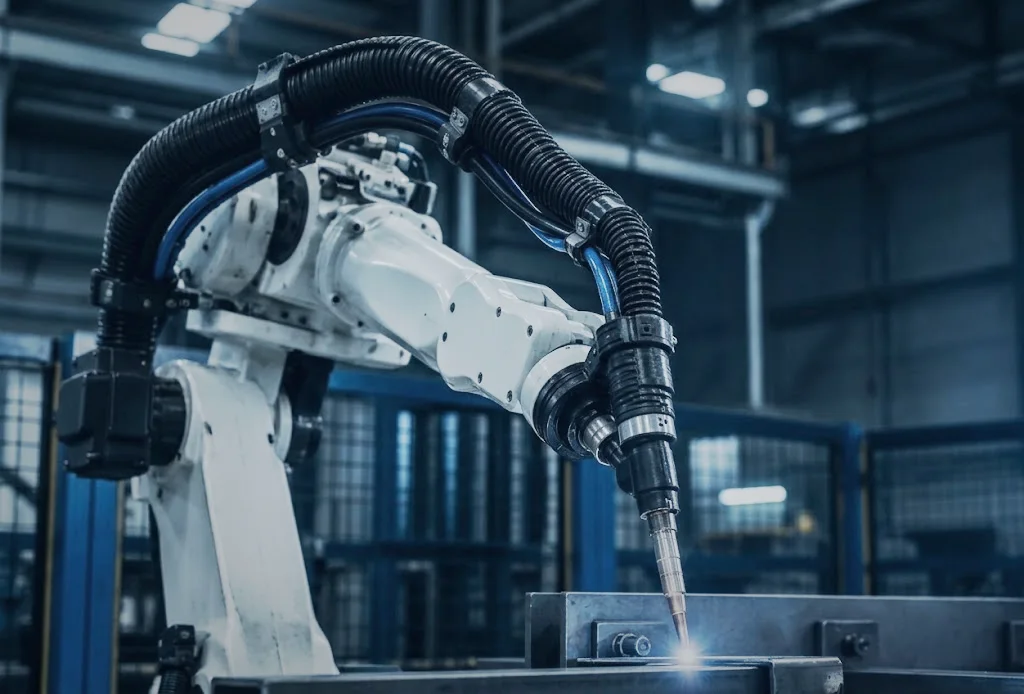
A dress pack is the package that bundles, protects and guides all cables and hoses running to a robot's tool. It consists of a corrugated protective hose, holders on each axis, a ball joint at the wrist and usually a retraction system on the upper arm.

What is a dress pack? A dress pack is the complete package around the cables and hoses that run to a robot's tool: a corrugated protective hose, holders that fix the hose on each axis or let it move along, and usually a retraction system. You will also hear hose package, robot dress pack or cable package for the robot. It always comes down to the same thing: the cabling follows the robot in every position, without kinking, chafing or getting caught in the cell.
Why does a robot need a dress pack?
An industrial robot moves in six axes at once. Everything that goes to the welding torch, gripper or spray nozzle moves with it: power, air, cooling water, signal and data. That bundle bends, rotates and twists with every cycle.
Without guidance, things go wrong in a few places. The bundle chafes along the arm, a loop strikes the cell or the workpiece, and at the wrist cables are kinked and twisted. You do not see this straight away. It only comes to light when a signal drops out or a cable breaks. How that happens and how to prevent it is explained in preventing cable breakage on your robot.
A dress pack lays the bundle in a fixed, generous bend along the arm. The hose protects, the holders determine where it is fixed and where it may slide, and the retraction system manages the length.
Which components make up a dress pack?
A Reiku dress pack is modular. You can have it assembled complete, but every component is also available separately. From the base to the tool, these are the components:
| Part | Place | Function |
|---|---|---|
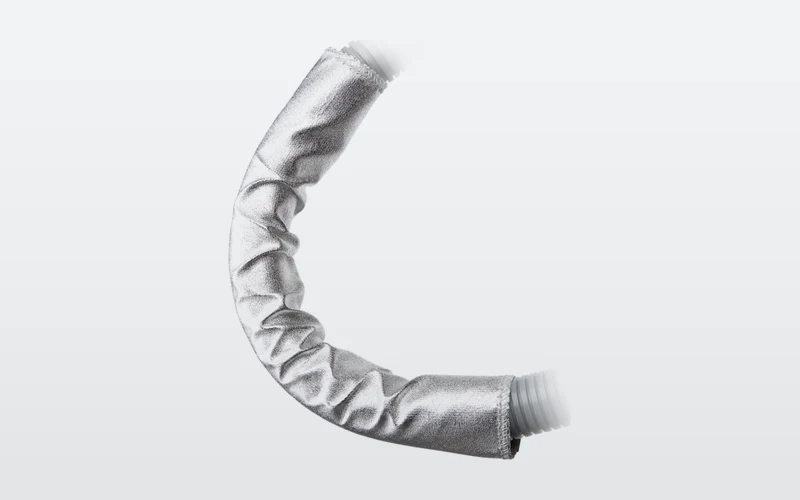
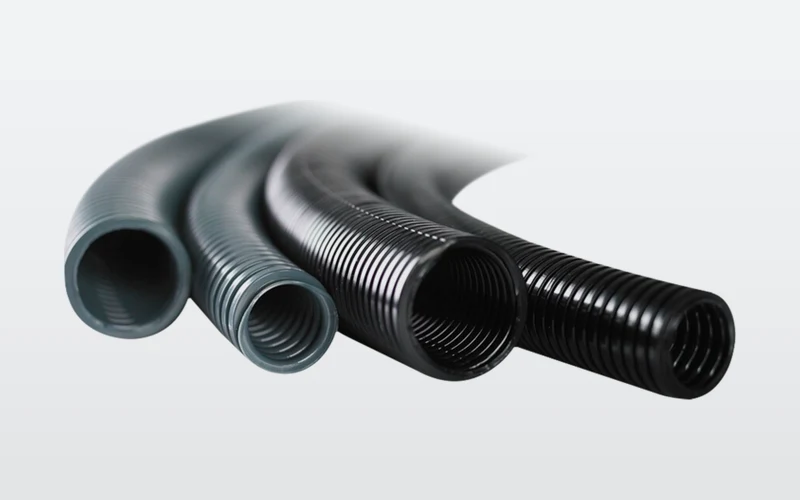
| Protective hose | Along the full length | Corrugated hose around the cables and hoses. Absorbs chafing, kinking and spatter |
| Rotary flange | As 1 | Holder on a rotating flange, so the package turns 360° with the base |
| Clamp | As 3 | Guides the hose on the upper arm, holds it in place or lets it slide through |
| Retraction system | Upper arm | Spring that pulls excess hose back when the robot retracts |
| Ball joint | Wrist, axes 4 and 5 | Lets the hose move along at an angle |
| End fitting | As 6 | Connects the hose to the welding torch, gripper or spray head |
The protective hose
The protective hose is the heart of the package. All cables and hoses run through it. Reiku makes the hoses from impact-resistant plastics such as PA 12, PA 11 and PUR, from extremely flexible to dimensionally stable and also conductive. At the points under the heaviest load, wear parts are fitted that you replace separately.
Holders and clamps
The holders and fixings determine how the hose runs over the robot. The system is a clamp with interchangeable clamping jaws. With one jaw the hose is fixed, with another it can slide through, so the length adapts to the robot's position. Clamps are available for hose sizes from 17 to 90 mm, with a nylon, metal or screw closure.
Ball joint
The robot rotates most at the wrist. The ball joint lets the hose pivot in the clamp there, so it follows the movement instead of working against it.
Retraction system
When the robot extends, the package needs more length than when it retracts. A retraction system is a spring on the upper arm that pulls the extra hose back. That way no loop hangs beside the arm. There are three versions: fixed guide, tilting and a ball type that moves ±12° in the clamp, for hose sizes from 17 to 70 mm.
Cables and hoses
What is inside the hose counts too. Choose cables made for continuous movement, with fine-stranded conductors and a wear-resistant sheath. A fixed installation cable is not designed for that. What to look for is explained in which cables belong in a cable carrier. For air or cooling water hoses: they swell under pressure, so leave room in the inner diameter.
What happens on each axis: axes 1 to 3 and axes 4 to 6?
You can roughly divide a robot into two parts, and the dress pack follows that division.
Axes 1 to 3 are the large movements: the rotating base, the lower arm and the upper arm. Here it is mainly about guidance. The rotary flange on axis 1 lets the package rotate with the base, the clamp on axis 3 takes over the hose on the upper arm. The movements are large, but they run over a long arm and are easy to guide.
Axes 4 to 6 are the wrist and the tool flange. Here the package rotates and bends the most, over a short distance. This is where the ball joint and the end fitting sit, and where the retraction system works hardest. Torsion, tight bends and rapid changes of direction come together. That is why most wear on the hose package occurs around the wrist.
You see this division in the build variants. There is a complete dress pack over axes 1 to 6, an upper arm package over axes 3 to 6 for robots where the cabling up to axis 3 is already well laid, a base package over axes 1 to 3 and a light cobot package without a retraction system. Which variant suits your robot and how to determine the hose size is explained in choosing a dress pack for your robot.
When do you need a dress pack?
As soon as something has to go to the tool that does not run through the robot itself, you need some form of guidance. In practice you will find dress packs on:
- Welding robots, with welding current, gas, cooling water and signal to the torch. See also dress pack for a welding robot.
- Handling and machine loading, with air and signal to the gripper
- Palletising, with large movements and a large difference in hose length
- Gluing, sealing and spraying, with hoses for the medium to the spray nozzle
- Cobots, with a light hose that keeps the arm free
A few signs that your current solution falls short: cable ties that keep breaking, a bundle that chafes along the arm, a loop that strikes the cell when extending, or the same cable failing again and again. Then a dress pack, or a better matched dress pack, is the next step.
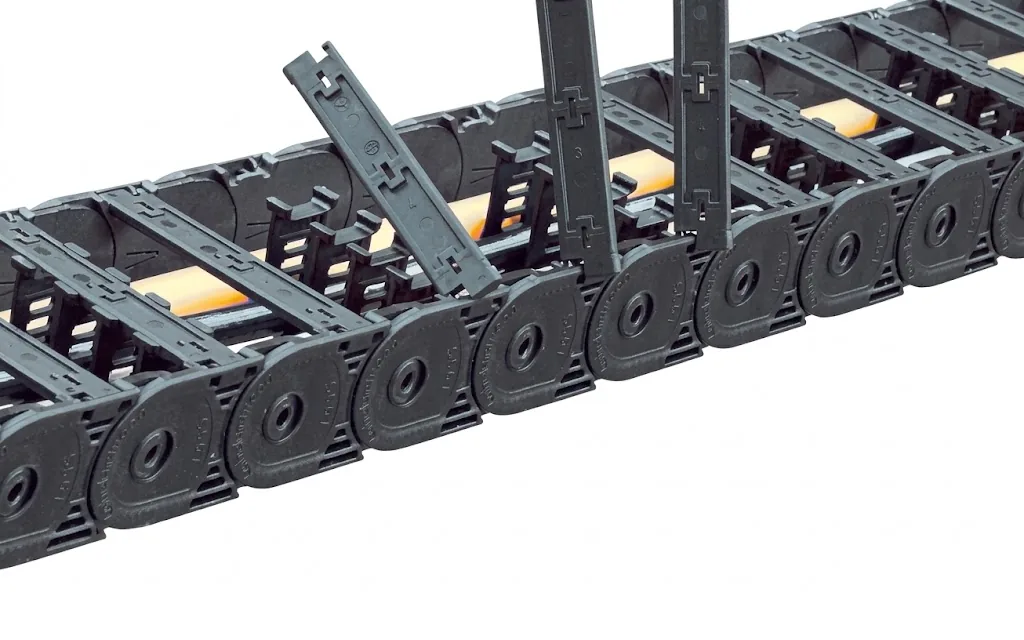
A dress pack is not the same as a cable carrier. A cable carrier is made for movement in one plane, a dress pack for movement in three dimensions. If the robot stands on a linear axis, the two come together: a cable carrier over the travel, such as a UNIFLEX Advanced, and a dress pack on the arm. The difference is explained on cable carrier or protective hose.
Complete dress pack or separate components?
Both are possible. The choice depends on what is already on your robot.
- (01)New robot or new process: choose a complete dress pack. Hose, holders and retraction system are then matched to each other and to your robot.
- (02)Existing package that is wearing: replace only what is worn, such as the hose, a clamp, a clamping jaw or the spring. Give us the robot model and hose size and we will find the matching parts.
- (03)Cabling up to axis 3 is fine: an upper arm package is often enough.
- (04)Cables must go in without disconnecting them: there are two-part, closable hoses that you fit around a bundle afterwards.
The advantage of one system: the hose size determines which clamps and which retraction system fit. If you choose them separately, you risk something not quite fitting.
Who supplies Reiku dress packs?
Wisman Techniek is an official Reiku partner. Our robot division supplies Reiku dress packs from engineering to installation. We assemble the package for your robot, feed the cables and hoses in at our workshop in Ruurlo and deliver it ready for installation. In the Netherlands and Belgium we also install it on site. More about the range is on the robot dress packs page.
How does the dress pack configurator work?
In the dress pack configurator you choose the make and model of your robot and the build. Then you assemble the hose, holders and fixing for each axis. If your model is not listed, type it in yourself and choose the robot class. If you choose a welding robot, heat protection is switched on by default.
You get a parts list with article numbers. Our robot division checks the package and adds cables and installation. Want to see straight away what fits your robot? Open the configurator and send in the parts list.
Calculate it yourselfDress pack configuratorConfigure a dress pack for your robotOpen the dress pack configuratorFrequently asked questions
What is the difference between a dress pack and a hose package?
There is no difference. Hose package, cable package, robot dress pack and dress pack are used interchangeably for the protective hose with holders and retraction system around a robot's cabling.
Which components make up a dress pack?
A protective hose, a rotary flange on axis 1, a clamp on axis 3, a retraction system on the upper arm, a ball joint at the wrist and an end fitting on axis 6. Not every build uses all components.
Does every robot need a retraction system?
Not always. For robots with a large reach or a big difference in hose length between retracted and extended, yes. The cobot package works without a retraction system.
Can I order separate dress pack components?
Yes. Protective hoses, clamps, clamping jaws, ball joints, retraction systems and wear parts are available separately, also as replacements in an existing package.
Does a dress pack fit every robot make?
Reiku dress packs fit the common industrial robots and cobots. In the configurator you choose the make and model. If your robot is not listed, ask us and we will measure it.
Next step
Calculate it yourself or browse the range. We check your result free of charge.
Series on this topic
Question about this topic?
Ask Daan directly
Robotics Division at Wisman Techniek