Short answer
The four dimensions that define a cable carrier are the inner height, the inner width, the bending radius and the pitch. Inner height and inner width determine what fits inside, the bending radius how far the cables bend and the pitch (the length of one link) the length in whole links.
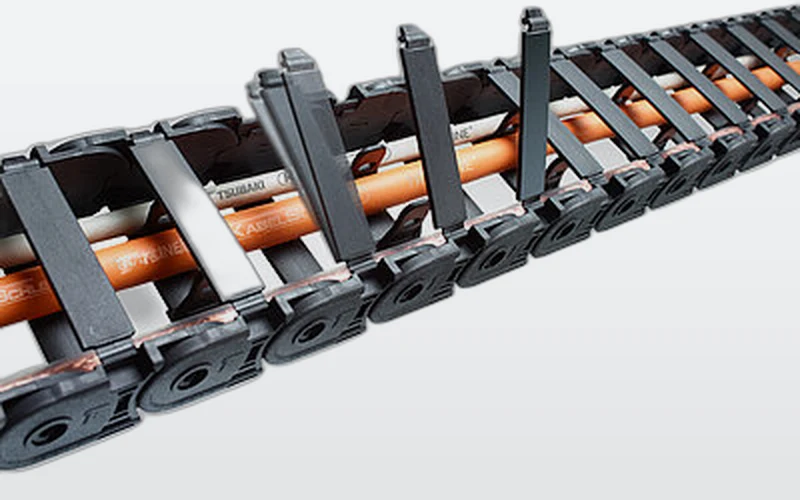
Four dimensions determine whether a cable carrier fits: the inner height (Hi), the inner width (Bi), the bending radius (KR) and the pitch. The first two determine what fits inside, the radius how far the cables bend and the pitch the length. The outer dimensions and the installation height then determine whether the carrier fits in your machine.
Anyone looking for or replacing a cable carrier is quickly faced with a list of dimensions. Below you can read what each dimension means, how to derive it from your cable package and how to measure an existing carrier.
What dimensions does a cable carrier have?
| Size | What it determines |
|---|---|
| Inner height (Hi) | The thickest cable or hose that fits inside |
| Inner width (Bi) | How many lines fit side by side |
| Bending radius (KR) | How far the cables bend in the curve |
| Pitch | The length of one link, and therefore the length increments |
| Outer height | The height of the link itself |
| Outer width | The width needed in the machine |
| Installation height (Hz) | The total height of the carrier including the bend |
Inner height and inner width are the clear dimensions inside the link. That is where the cables and hoses lie, with clearance. The outer dimensions are for installation: they have to fit in the space the machine offers.
Inner height and inner width: how much clearance?
Cables and hoses must not lie tight in the carrier. They move, expand with heat, and hoses swell under pressure. That is why the site uses an effective diameter:
- Cables: diameter × 1.10
- Hoses: diameter × 1.20
The minimum inner height is the largest effective diameter. The minimum inner width is the sum of all effective diameters, plus room for dividers. A 20 mm cable therefore needs at least 22 mm inner height, a 12 mm hose at least 14.4 mm.
The other way round: for a given inner height, the thickest cable is about inner height / 1.1. Each type also lists a maximum cable diameter in its data. If that is smaller, it takes precedence. For example, the UNIFLEX Advanced 1455 has an inner height of 26 mm and a maximum cable diameter of 20.5 mm.
Whether everything also has enough room is shown by the fill level: below 85% is good, between 85 and 90% tight and above that too full. The fill level calculator works out the required inner dimensions and the fill level in one go.
Calculate it yourselfCalculate fill levelRequired inner dimensions and fill levelCalculate itBending radius and pitch: the dimensions for movement and length
The bending radius is the radius of the bend. It follows the thickest or most sensitive cable: at least 7.5 times the thickest diameter, 10 times with many movements, or the datasheet value if that is larger. Each type has a fixed list of radii. How to choose is explained in determining the bending radius.
The pitch is the length of one link, measured centre to centre between two pivot points. A cable carrier is always supplied in whole links, so the length goes up in steps of the pitch. With a pitch of 45.5 mm, a carrier of 46 links is 2093 mm long. The length calculator does the rounding for you.
Outer dimensions and installation height: does the carrier fit in the machine?
The outer width is the inner width plus the side walls. In the type data it is given as a fixed addition to the inner width. On the UNIFLEX Advanced 1455 that is 16 mm: with an inner width of 103 mm, the carrier is 119 mm wide.
The installation height is roughly 2 × KR + outer height. The 1455 has an outer height of 36 mm, so with KR 150 the installation height is 336 mm. A larger radius therefore makes the carrier taller, even if the inner dimensions stay the same. How all these dimensions come together in a complete calculation is explained in calculating a cable carrier in six steps.
How to read the data of a type
Each series page lists the types with their dimensions. Two examples from the range:
| Type | Hi | Bi | Pitch | Radii |
|---|---|---|---|---|
| UNIFLEX Advanced 1455 | 26 mm | 25, 38, 58, 78, 103, 130 mm | 45,5 mm | 52–200 mm |
| M0650 | 38 mm | 75–400 mm | 65 mm | 75–350 mm |
Note the difference in width. The UNIFLEX Advanced 1455 has fixed inner widths: you choose the next size above what you need. For the M0650 only a range is given and you choose the width within that range. See the types on the pages of the UNIFLEX Advanced and the M series, or search by inner height and inner width in the overview of plastic cable carriers.
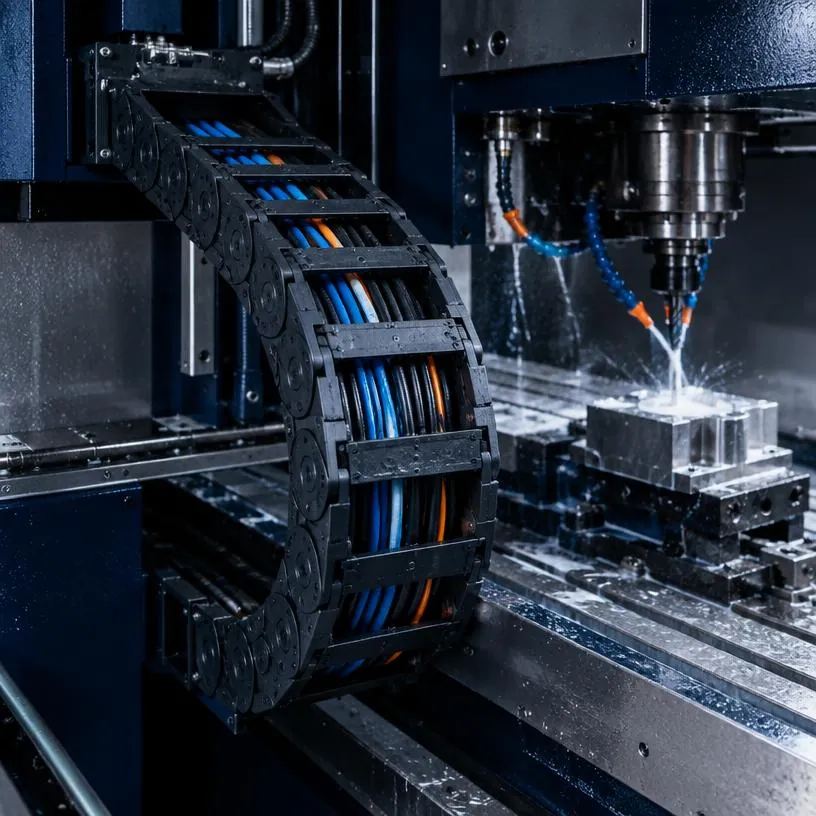
Measuring an existing cable carrier
Does a carrier need replacing and is the type plate illegible? Then measure these dimensions:
- (01)Inner height and inner width: inside of the link, between the side walls and between the bottom and the crossbar
- (02)Outer width and outer height: across the outside of the side walls and from bottom to top
- (03)Pitch: centre to centre between two hinge pins, or measure ten links and divide by ten
- (04)Radius: measure the inside of the bend and add half the outer height, or measure the bend centre to centre
- (05)Length: count the number of links
With those dimensions, the Replacement guide finds a replacement from the range. If you only need individual links or mountings, look at parts. If you are unsure whether to replace or repair, read replace or repair.
From dimensions to a suitable carrier
If you have the dimensions of your cable package and know the travel length, the Cable carrier configurator can do the rest: filter types by inner dimensions, radius, installation height and installation width, and calculate the length in whole links. Heavy or large packages often end up with steel cable carriers. A specialist checks the result free of charge, or you can request a quote directly.
Calculate it yourselfCable carrier configuratorCalculate, select and assemble a cable carrierOpen the cable carrier configuratorFrequently asked questions
What is the inner height of a cable carrier?
The clear height inside the link. It must be at least the thickest cable × 1.1, or the thickest hose × 1.2. Each type also lists a maximum cable diameter in its data.
What is the pitch of a cable carrier?
The length of one link, centre to centre between two pivot points. The carrier is supplied in whole links, so the length is always a multiple of the pitch.
How do you measure the pitch of a cable carrier?
Measure across ten links, centre to centre of the hinge pins, and divide by ten. That is more accurate than measuring a single link.
How do you calculate the installation height of a cable carrier?
Twice the bending radius plus the outer height of the link. A carrier with KR 150 and an outer height of 36 mm has an installation height of about 336 mm.
Which dimensions do I need to replace a cable carrier?
Inner height, inner width, outer width, pitch, radius and the number of links. With a photo of the carrier and the mountings, a specialist can find a suitable type faster.
Next step
Calculate it yourself or browse the range. We check your result free of charge.
Series on this topic
Question about this topic?
Ask Bas directly
Cable Carriers Specialist at Wisman Techniek