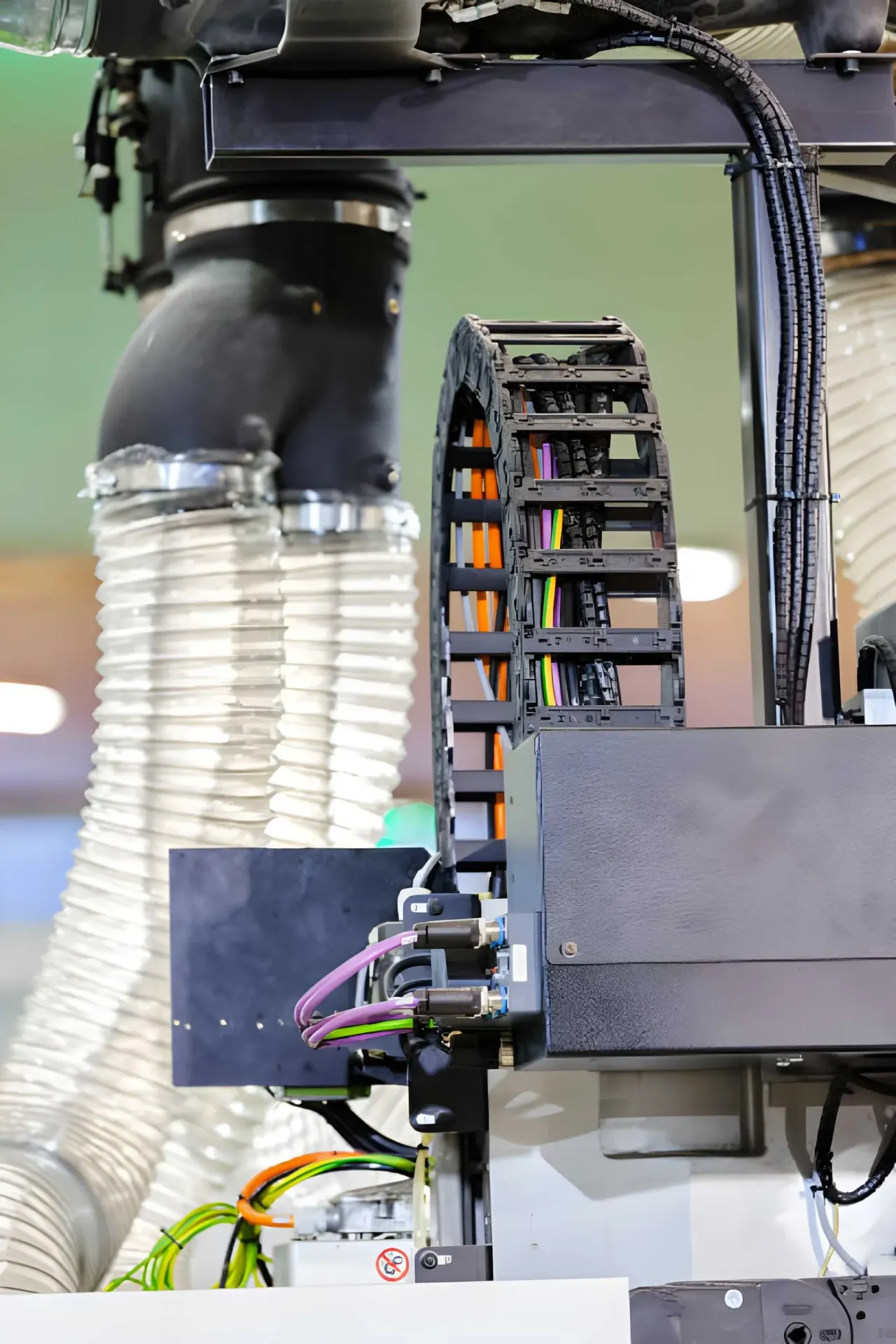
Short answer
Give every cable 10% and every hose 20% clearance on its diameter and keep the fill level below 85% of the inner cross-section. Distribute the weight symmetrically, place heavy cables on the outside and separate cables and hoses with dividers.
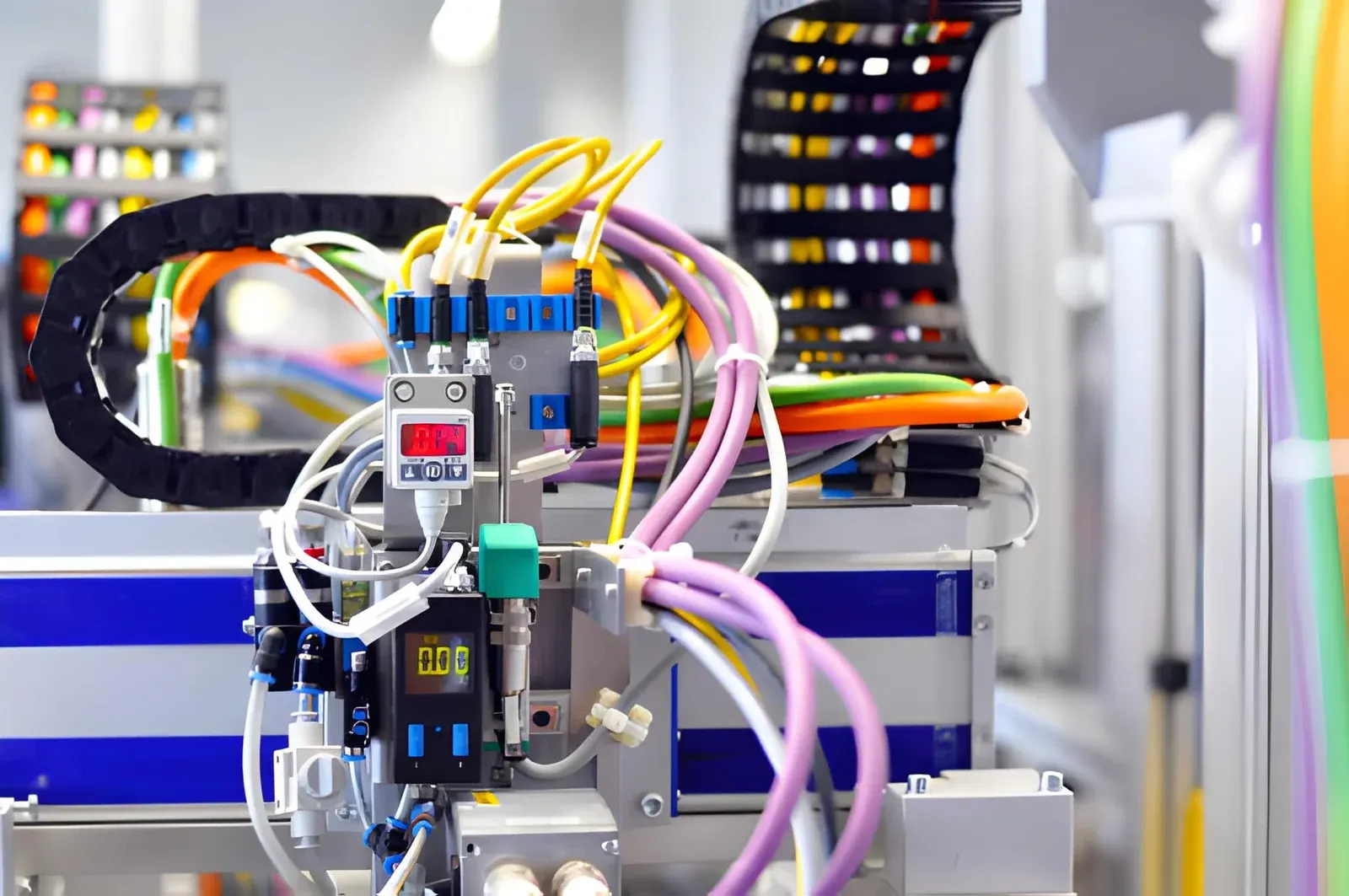
A well laid out cable carrier gives every cable and hose enough room and a fixed position: 10% clearance for cables, 20% for hoses and a fill level below 85%. Dividers and a shelf keep the package in place. That determines how long your cables last, because a cable that lies too tight or too loose wears in the bend.
What is the difference between fill level and additional load?
The fill level tells you how much of the inner cross-section of the carrier is filled. You calculate with the effective diameter of each cable and hose, so including clearance, and divide the total area by inner width times inner height.
The additional load is the weight of all cables and hoses per metre of carrier, hoses including their contents. The fill level determines whether the package fits and can move freely. The additional load determines which series can carry the package and whether the carrier can run self-supporting.
You need both. A carrier can be roomy enough and still be overloaded, or lightly loaded and still too tight.
How much room does a cable need in a cable carrier?
Cables get warm and expand slightly, hoses swell under pressure and change in length. That is why we calculate with this clearance on the site:
- Cables: effective diameter = diameter × 1.10
- Hoses: effective diameter = diameter × 1.20
- Inner height: at least the largest effective diameter in the package
- Inner width: at least the sum of all effective diameters side by side
Conversely, the thickest cable in a carrier is at most the inner height divided by 1.1. With an inner height of 38 mm that is about 34.5 mm. Never place cables of different diameters on top of each other without a shelf, because they will roll over each other and start to twist. What that leads to is described under cables twisting in the carrier.
Calculating the fill level: a worked example
Take a package of two POWER 700 C 1kV 4G2.5 power cables (11.9 mm), four CONTROL 400 600V 7G1 control cables (9.4 mm) and two 12 mm pneumatic hoses. The cable diameters come from our TRAXLINE range.
| Line | Quantity | Diameter | Effective | Combined width |
|---|---|---|---|---|
| POWER 700 C 4G2,5 | 2 | 11,9 mm | 13,1 mm | 26,2 mm |
| CONTROL 400 7G1 | 4 | 9,4 mm | 10,3 mm | 41,4 mm |
| Hose | 2 | 12,0 mm | 14,4 mm | 28,8 mm |
| **Total** | 8 | **96,3 mm** |
The inner height must be at least 14.4 mm (the hose) and the inner width at least 96.3 mm. The area of all effective cross-sections together is about 931 mm².
If you choose a UNIFLEX Advanced with 26 mm inner height and 103 mm inner width, the fill level is 931 / (103 × 26) = 35%. Well below the 85% limit. But with two 3 mm dividers the required width becomes 102.3 mm. That just fits, with no reserve. The next width of 130 mm leaves room for an extra cable later.
This example shows that the fill level alone is not enough. Always also check whether the lines fit side by side. With calculate fill level you can check your own package: you see the minimum inner dimensions and, once you add the dimensions of a carrier, the fill level.
Calculate it yourselfCalculate fill levelRequired inner dimensions and fill levelCalculate itWhen do you use dividers and a shelf?
A divider is a vertical partition between the crossbars. It divides the inner width into compartments so that every cable keeps its own lane. In ChainLogic we use 3 mm for plastic and 4 mm for steel as standard, with at least 5 mm to the side wall and 10 mm between two dividers. Where the type data of a series specifies its own dimensions, those apply.
A shelf is a horizontal plate across the full inner width. It divides the inner height into two levels. That is useful when the package gets too wide, but each level must then be high enough. In the example above, with 26 mm inner height and a 2 mm shelf, about 12 mm remains per level: enough for the 7G1 cables, too little for the hoses.
Use dividers in these situations:
- You combine cables and hoses in one carrier
- Power and signal cables must be kept apart
- Cables with very different diameters lie side by side
- You want to keep a compartment free for a cable that will be added later
How to lay out the cable package, step by step
- (01)Make a cable list with the diameter, weight per metre and minimum bending radius of every cable and hose. Only use cables suitable for a cable carrier.
- (02)Determine the inner dimensions with the 10% and 20% clearance. Also check the minimum bending radius of the thickest cable.
- (03)Distribute symmetrically: left and right roughly equally heavy, so the carrier keeps running straight.
- (04)Place heavy items on the outside: the heaviest cables and hoses at the sides, light cables in the middle.
- (05)Separate with dividers: cables and hoses apart, power and signal apart.
- (06)Check the fill level: below 85% is good, between 85 and 90% is tight, above 90% is too full.
- (07)Keep a reserve for expansion, even if the package fits exactly now.
In ChainLogic you draw that layout in the cross-section. You drag cables, hoses and dividers into place and immediately see whether a line collides with a wall, divider or neighbouring cable. The tool shows the fill level of the carrier and gives a tip if more than 5 mm remains unused at the side or top. You can save the result as a PDF with a parts list.
Calculate it yourselfChainLogicLay out cables, hoses and dividers in the cross-sectionOpen ChainLogicWhat does the additional load mean for the choice of carrier?
The weight per metre is in the datasheet of every cable. In the example the cables together weigh about 0.94 kg per metre (2 × 0.214 and 4 × 0.127 kg/m), plus the hoses with their contents.
The heavier the package, the shorter the length the carrier can span self-supporting. A heavier package means:
- More sag of the upper run in a self-supporting installation
- More load on links, crossbars and end connectors
- Possibly a taller series, a gliding installation or a steel carrier
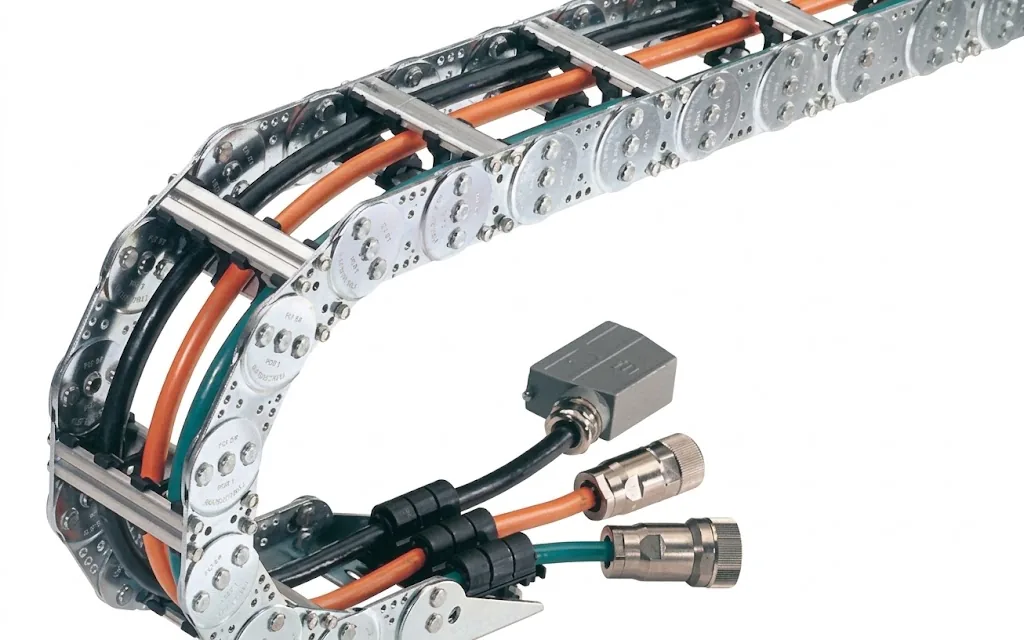
If you are unsure whether to go self-supporting or gliding, first read self-supporting or gliding. With heavy packages of hoses and thick power cables, steel cable carriers also come into view, such as the S/SX with crossbars you can lay out freely.
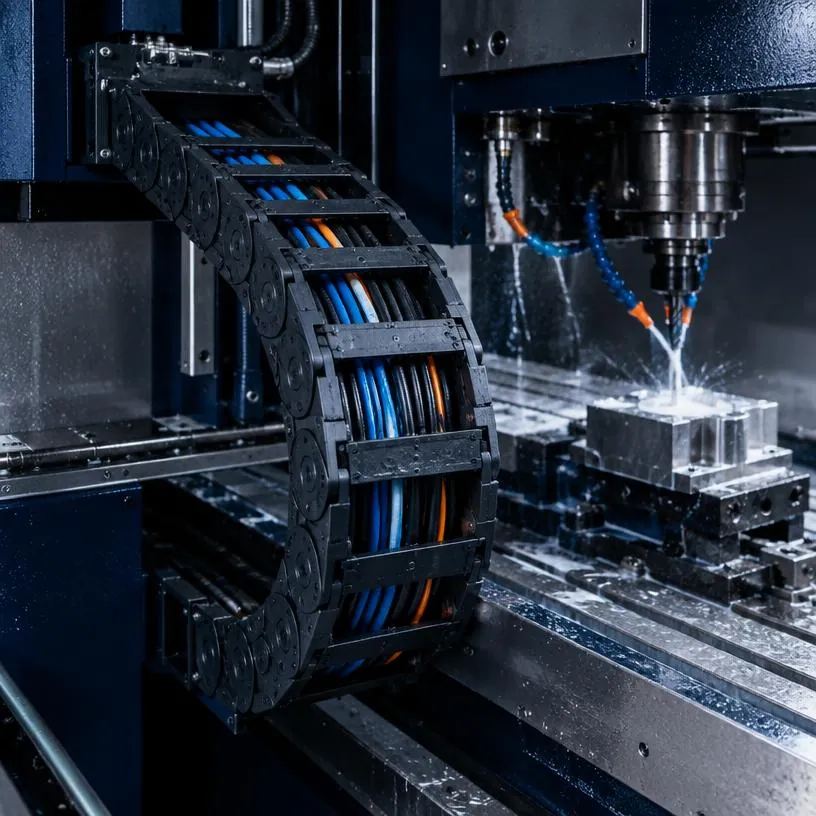
The cable carrier configurator finds the types that suit your cable package and travel length, including a check whether self-supporting is still possible. We check the result free of charge, and for a heavy or wide package we work out the layout with you through a quote request.
Frequently asked questions
How full can a cable carrier be?
Keep the fill level below 85% of the inner cross-section, calculated with the effective diameters. Between 85 and 90% is tight: the cables then have little room to move in the bend. Above 90% the carrier is too full.
How much clearance does a cable need in a cable carrier?
Calculate with 10% of the diameter for cables and 20% for hoses. A 10 mm cable therefore needs a compartment of at least 11 mm, a 10 mm hose a compartment of 12 mm.
Can cables lie on top of each other in a cable carrier?
Only if they have the same diameter, or with a shelf in between. Otherwise cables roll over each other, start to twist and rub against each other in the bend.
Where do you place heavy cables in the carrier?
On the outside, distributed symmetrically between left and right. Light cables go in the middle. That way the carrier keeps running straight and the links are loaded evenly.
What is the difference between a divider and a shelf?
A divider stands vertically and divides the width into compartments. A shelf lies horizontally across the full width and divides the height into two levels. In ChainLogic you can use both in one carrier, with at most one shelf in the middle of the inner height.
Next step
Calculate it yourself or browse the range. We check your result free of charge.
Series on this topic
Question about this topic?
Ask Bas directly
Cable Carriers Specialist at Wisman Techniek