Short answer
Before you buy a cable carrier, gather the travel length, speed, cable list, installation space and environment. With these you choose the series, inner dimensions and radius. The price depends mainly on series, width, material, length, accessories and whether you have the carrier supplied on its own or complete with cables.
Anyone who wants to buy a cable carrier starts not with the price but with the data of the movement: travel length, speed, cables and space. With that data you choose the series, the inner dimensions and the bending radius. Only then can you compare prices and quotes fairly. A carrier that is slightly too tight or too light will cost you more later than the difference at purchase.
What data do you need to order a cable carrier?
Ordering a cable carrier is quicker if you have this data to hand. If you don't know something exactly, give an estimate and say so.
- (01)Travel length: the total stroke of the movement, in millimetres or metres.
- (02)Speed and acceleration: how fast the machine moves and how hard it accelerates and brakes.
- (03)Arrangement: horizontal, vertical, hanging or on its side, and whether the carrier can be self-supporting or has to glide.
- (04)Cable list: every cable and hose with its outer diameter and, if you know it, the weight per metre.
- (05)Installation space: how much height and width there is for the carrier and the bend.
- (06)Fixed point: where the carrier is attached to the machine, preferably in the middle of the travel.
- (07)Environment: clean, chips, dirt, outdoors, heat or chemicals.
- (08)Quantity: one machine or a series.
A photo or drawing of the situation always helps. How to get from this data to inner dimensions and radius is explained step by step in calculating a cable carrier.
What determines the price of a cable carrier?
A cable carrier has no fixed price per metre. The price follows from a few choices, and they all depend on your application.
- Series: a light series for short strokes is simpler than a heavy series for long travel lengths.
- Width and height: a wider carrier has longer crossbars and more material per link.
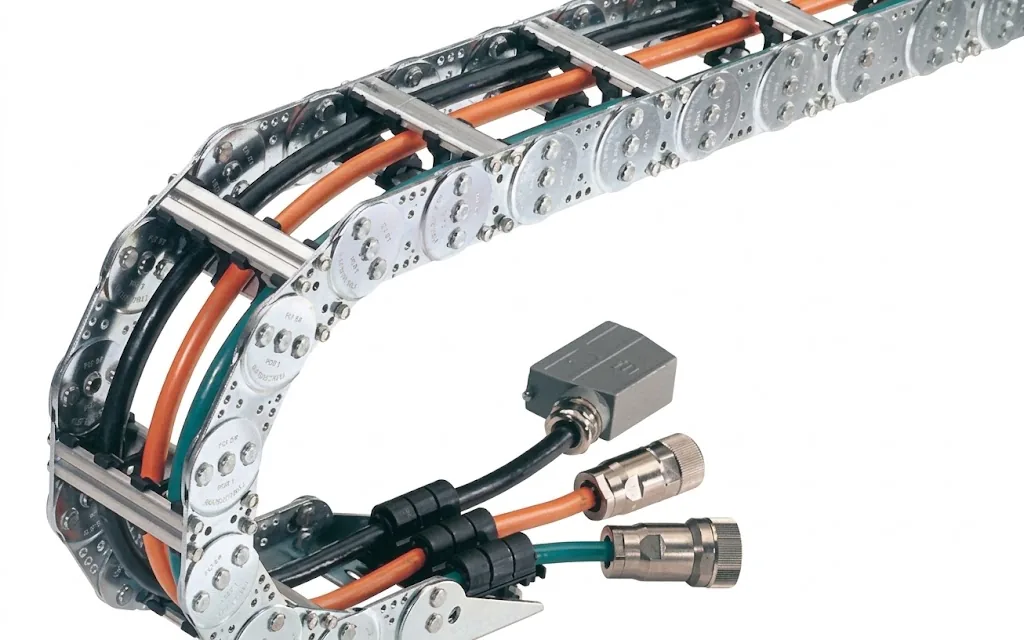
- Material: plastic is lighter and more economical. Steel, in galvanised steel or stainless steel, is what you choose for heavy loads, heat and chips.
- Open or closed: closed cable carriers have covers and are heavier than open carriers.
- Length: the carrier is made in whole links. With a fixed point in the middle, that is roughly half the travel length plus the bend.
- Accessories: end brackets, separators, height dividers, strain relief and, for gliding applications, a guide channel.
- Assembly: an empty carrier or a carrier fully filled with cables and hoses.
So don't just look at the price of the carrier itself. An inexpensive carrier without end brackets or channel cannot be compared with a complete set.
Calculate it yourselfCalculate cable carrier lengthLength and number of links from travel length and radiusCalculate itWhich cable carrier do you choose if you're unsure?
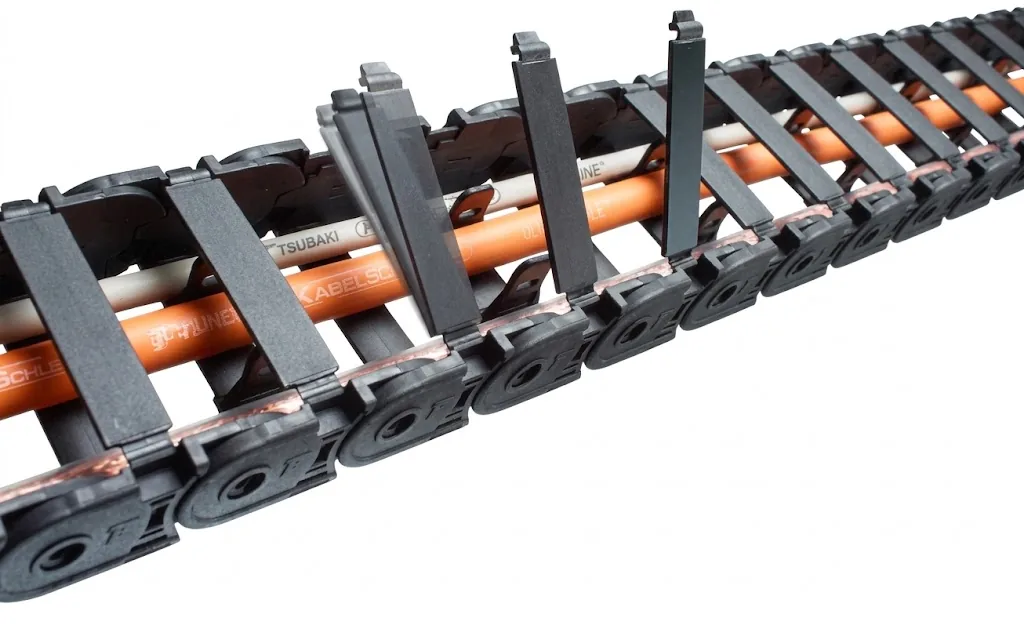
For most machines we start with the UNIFLEX Advanced. It is a plastic all-rounder, available in many widths, that can be used self-supporting and gliding. In our data the inner height ranges from 17.5 mm (UA1250) to 80 mm (UA1995). A UA1455 goes up to 4.8 m travel self-supporting and up to 120 m gliding.
If you are looking for a simple carrier for a smaller application, look at QuickTrax. For very small cables and little space there is the MONO, with inner heights from 10 to 15 mm.
If heat, chips or heavy loads are involved, you end up with a steel carrier. Read more about that choice in steel or plastic. For a very long travel length you need a series designed to glide; see cable carrier for a long travel length.
How quickly can a cable carrier be delivered?
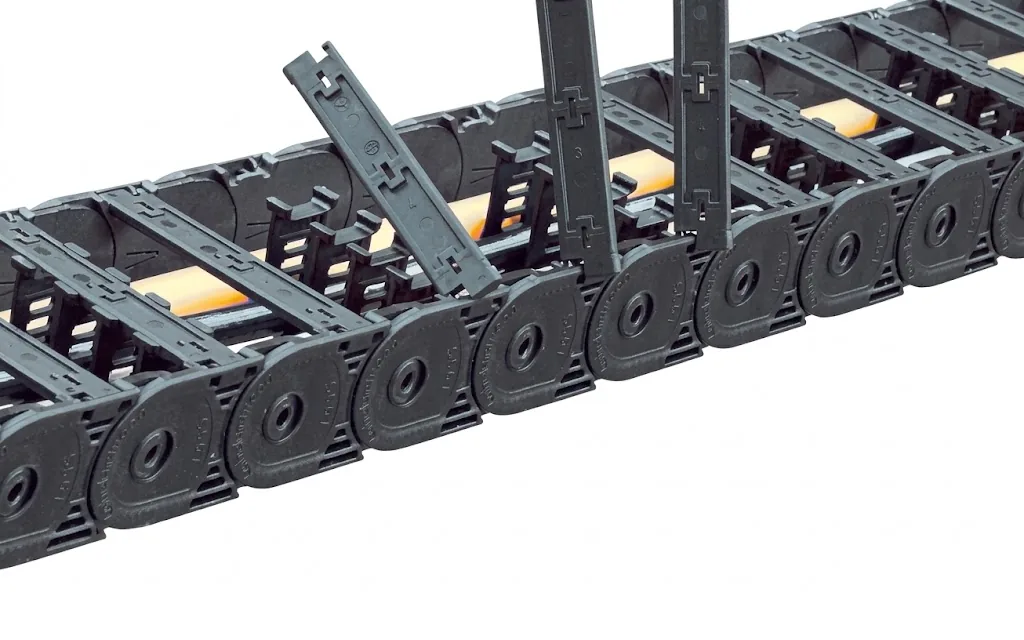
We have more than 5,000 items in stock in Ruurlo. For stock items the delivery time is 1-3 working days. If you order before 14:00, a stock order often leaves the same day.
If the carrier has to be cut to length or fully assembled, it goes through our workshop first. Steel carriers and special versions come from stock or via the factory, depending on type and version. The delivery time stated in the quote is what counts. The delivery and lead times page explains how it works for each product group.
If a machine is at a standstill, call us straight away. We'll check what is in stock and what the fastest route is. For individual links, crossbars and end brackets, go to spare parts.
Buy a cable carrier on its own or fully assembled?
You can buy a cable carrier on its own and fill it yourself. That makes sense if you have your own fitters and the cables are ready. The carrier then comes cut to length, with end brackets and separators.
You can also have it supplied complete: cut to length, filled with cables and hoses, with strain relief and connectors. In Ruurlo we assemble around 1 million metres of cable carrier to size every year. The advantage is that the layout is right, the cables are the correct length and the carrier is ready to install.
If you fill it yourself, pay attention to the cables. Only cables made for continuous movement belong in a cable carrier. A standard installation cable will eventually break in the bend. How to choose cables is explained in which cables for a cable carrier. Our flexible cables come from the TRAXLINE range by Tsubaki Kabelschlepp.
How do you compare two quotes for a cable carrier?
Two quotes with a different amount are often for a different carrier. Put them side by side using this checklist:
| Check | Why it matters |
|---|---|
| Series and type | A lighter type may not be able to handle your travel length or speed |
| Inner height and inner width | Too tight means cables that chafe and break |
| Bending radius | Smaller than your cables can handle costs service life |
| Length in links | Too short pulls on the fixed point, too long sags |
| Self-supporting or gliding | Gliding requires a guide channel and a suitable series |
| End brackets and separators | Not always included, but needed |
| Cables and assembly | Empty carrier or fully filled, with which cable class |
| Guide channel and installation | A considerable part of the whole on long travel lengths |
| Lead time | From stock or via the factory |
If the inner dimensions, radius and length are not stated, ask for them. Without that data you don't know whether the carrier fits your machine. If you want to replace an existing carrier, the Replacement Finder finds a suitable type based on what is fitted now.
From configurator to quote: how to order
You can start in two ways. If you want to calculate it yourself, open the Cable Carrier Configurator. You enter the movement and your cables, and the configurator only shows the series that can handle the load. You get a bill of materials and a 3D model for your designer. A specialist checks every configuration free of charge.
If you'd rather we did the calculation, send your data via a quote request. The quote assistant asks you the questions a specialist would ask, and you can attach a drawing or photo. Within 1 working day you receive a proposal with a price, with an alternative where needed.
Calculate it yourselfCable carrier configuratorCalculate, select and assemble a cable carrierOpen the cable carrier configuratorFrequently asked questions
What does a cable carrier cost?
That depends on series, width, material, length, accessories and whether you have it supplied complete with cables. A price per metre therefore says little. Send your data and you'll receive a proposal with a price within 1 working day.
Can I buy a cable carrier by the metre?
A cable carrier is made in whole links. So you order a length that suits your travel length and radius. We calculate that length for you, or you calculate it yourself with the calculator for the length of a cable carrier.
How soon will I receive a cable carrier?
We deliver stock items in 1-3 working days. Ordered before 14:00, a stock order often leaves the same day. Carriers that are cut to length or assembled go through our workshop first.
Do you supply the cables as well?
Yes. On request we supply carriers complete: cut to length, filled with TRAXLINE cables and hoses and with strain relief and connectors. You can also order the carrier on its own and fill it yourself.
Which cable carrier is most common?
For most machines the UNIFLEX Advanced is a good starting point. For smaller applications look at QuickTrax or MONO, for heavy loads and heat at a steel carrier.
Can I also order individual parts for my cable carrier?
Yes. Individual links, crossbars and end brackets are available. State the type of your carrier in the request.
Next step
Calculate it yourself or browse the range. We check your result free of charge.
Series on this topic
Question about this topic?
Ask Bas directly
Cable Carriers Specialist at Wisman Techniek