Short answer
Choose plastic for most machines, because it is light, quiet, corrosion-free and economical. Choose steel for heavy cable packages over long self-supporting lengths, for heat and hot chips, or for heavy mechanical loads.
For most machines a plastic cable carrier is the best choice: light, quiet, corrosion-free and economical. You choose steel when the cable package is heavy and has to span a long length unsupported, or when heat, hot chips or heavy loads ask too much of plastic. The choice determines the weight, price and service life of the entire energy supply, so it pays to make it deliberately.
What is the difference between a steel and a plastic cable carrier?
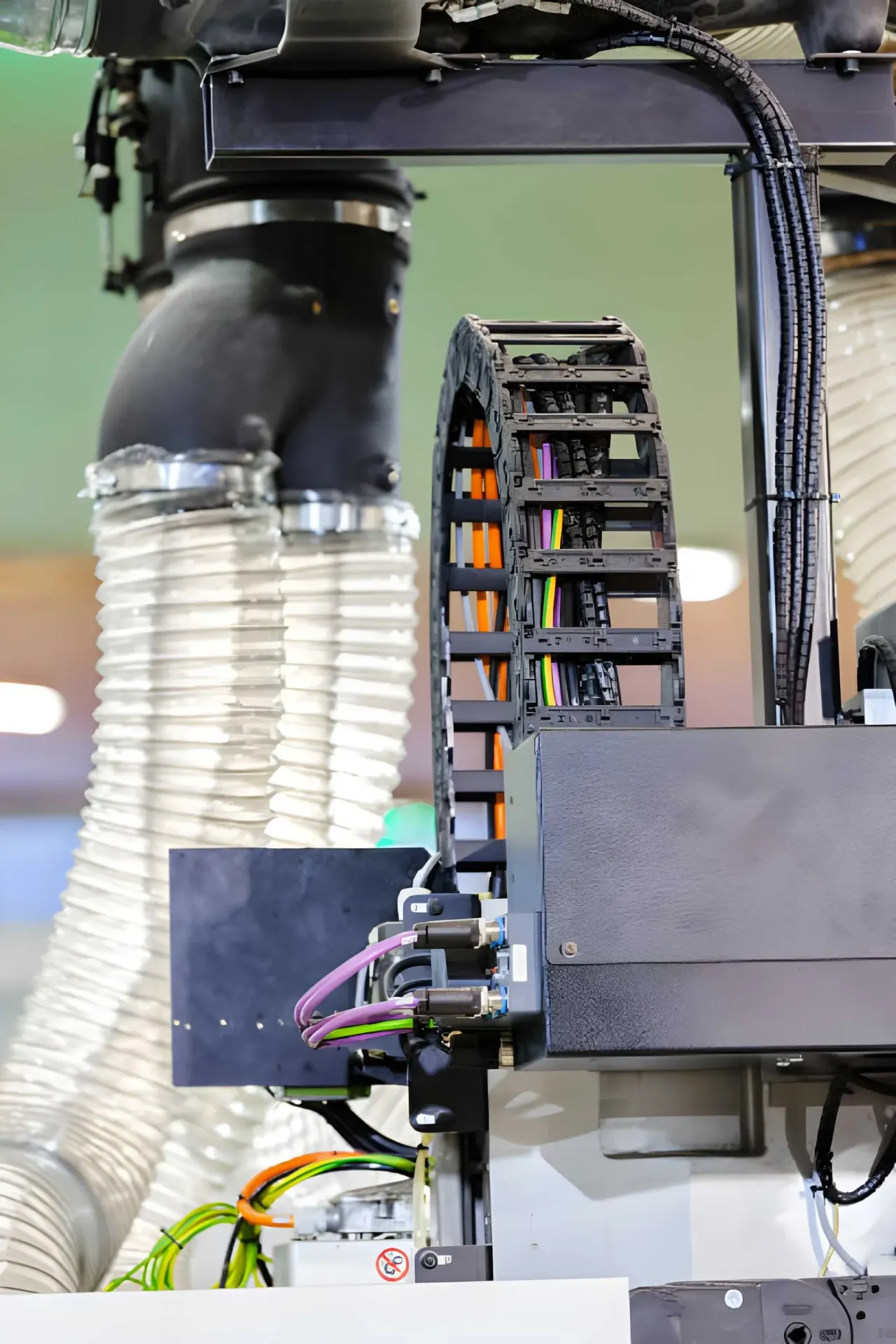
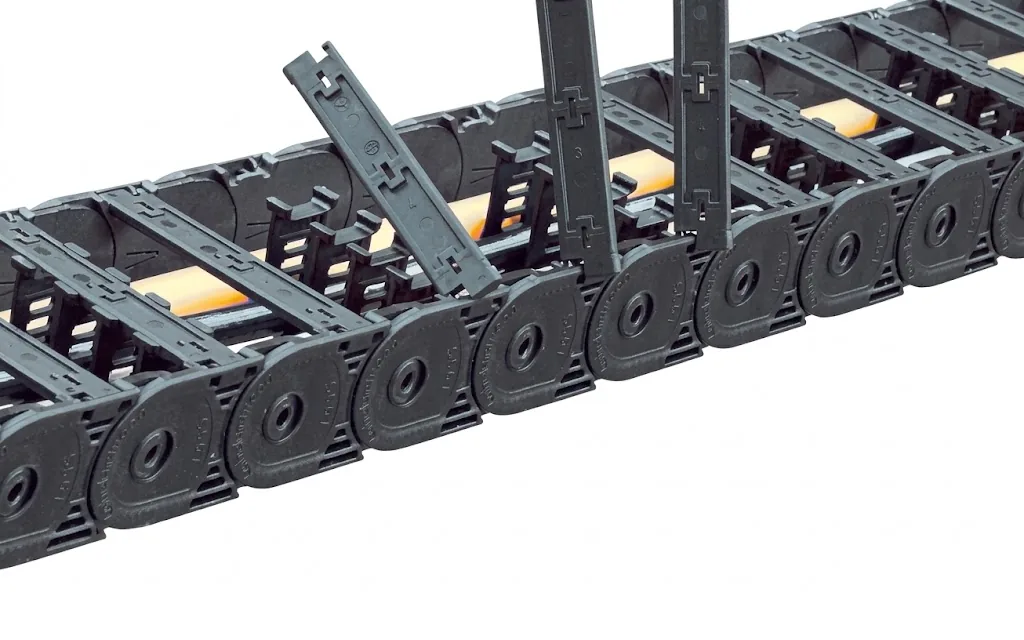
A plastic cable carrier is made of glass-fibre reinforced polyamide. Links, side plates and crossbars are plastic, often with crossbars that open on the inside or outside. The range runs from small carriers for compact axes to wide carriers with separators.
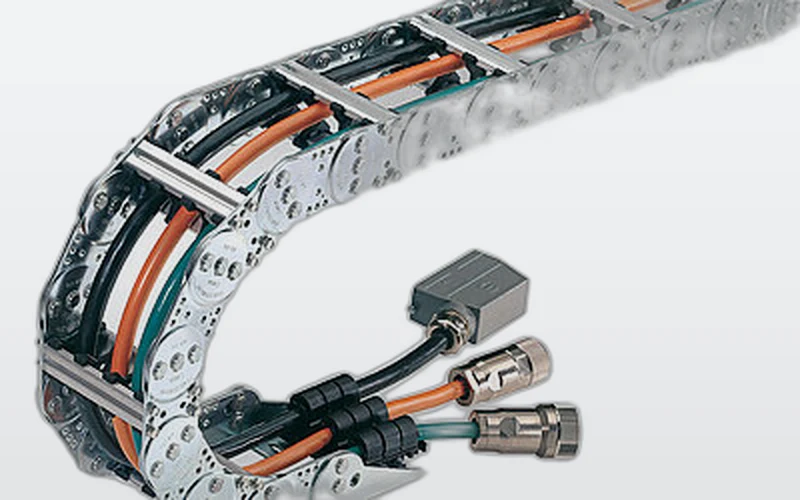
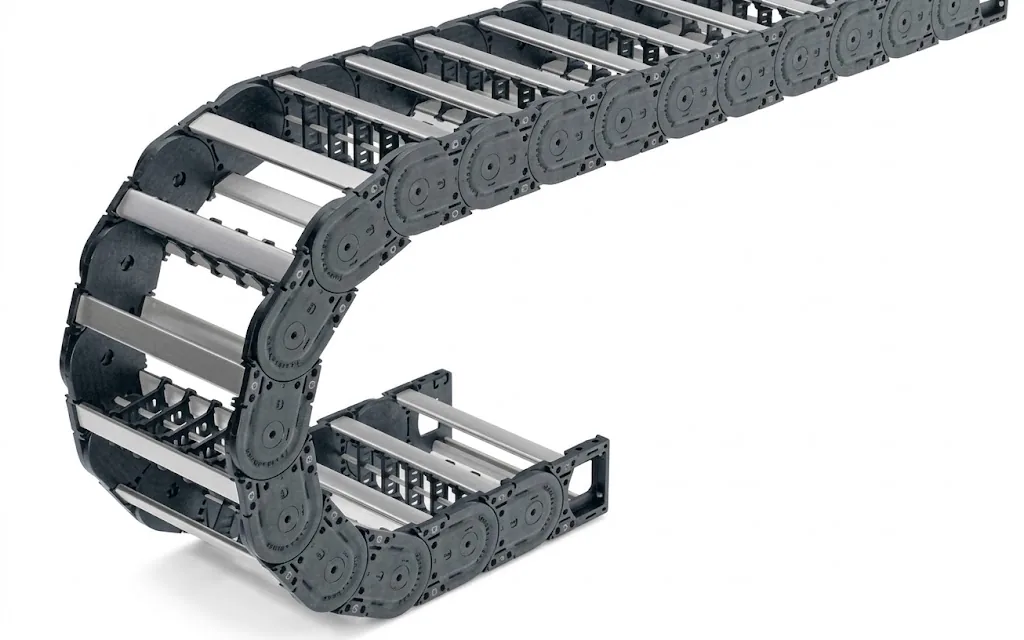
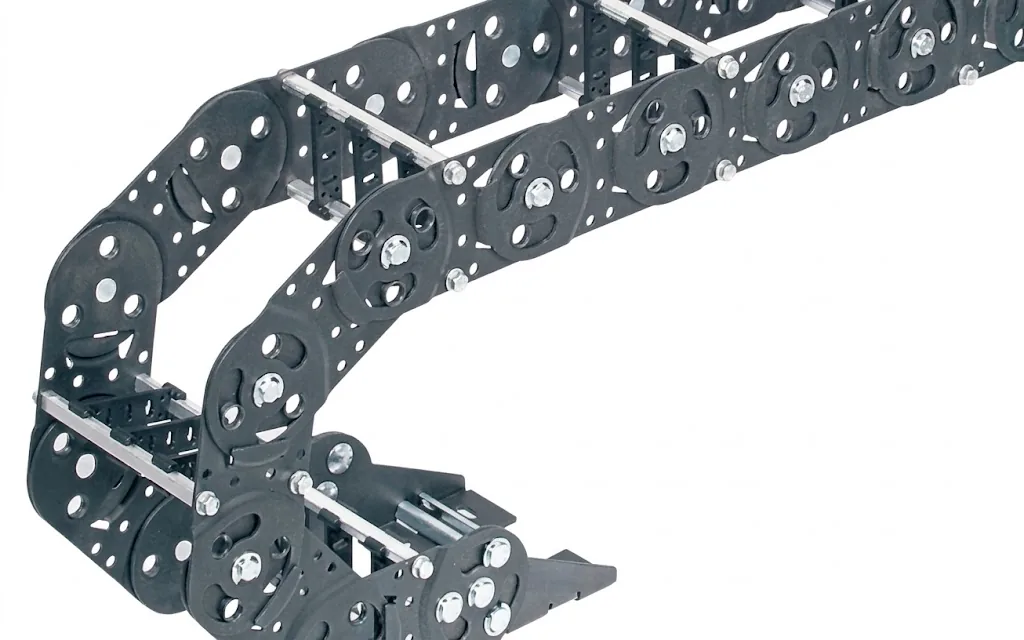
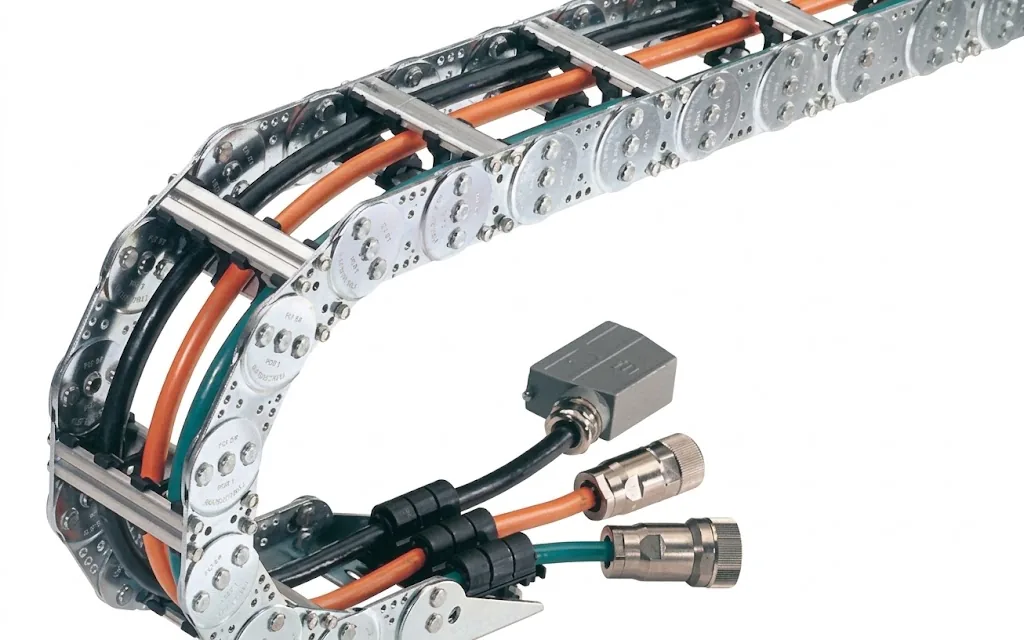
A steel cable carrier has steel side plates with aluminium or steel crossbars. The S version is galvanised, the SX version stainless steel. Steel carriers are almost always custom-made in width and layout.
The difference in range shows in the dimensions. Of the series in our range, the plastic carriers go up to 1000 mm inner width and 108 mm inner height. The steel S/SX series goes up to 1650 mm inner width, 220 mm inner height and a bending radius of up to 1785 mm.
When do you choose a plastic cable carrier?
Plastic is the standard for machine tools, handling, packaging, robotics and most production lines. Its strengths:
- Light: less moving mass, so higher speeds and accelerations with the same drive
- Quiet: damped series such as QUANTUM® and TKR for machines where people work alongside
- Corrosion-free: no rust in wet, cold or cleaning-intensive environments
- Quick to fill: opening crossbars, so you lay cables in without dismantling the carrier
- Economical to buy and maintain
Chips or dirt need not be a reason for steel. An enclosed plastic carrier such as the MT or TKA keeps chips and dirt out. If you want a quietly running machine, also read how to choose a quiet cable carrier.
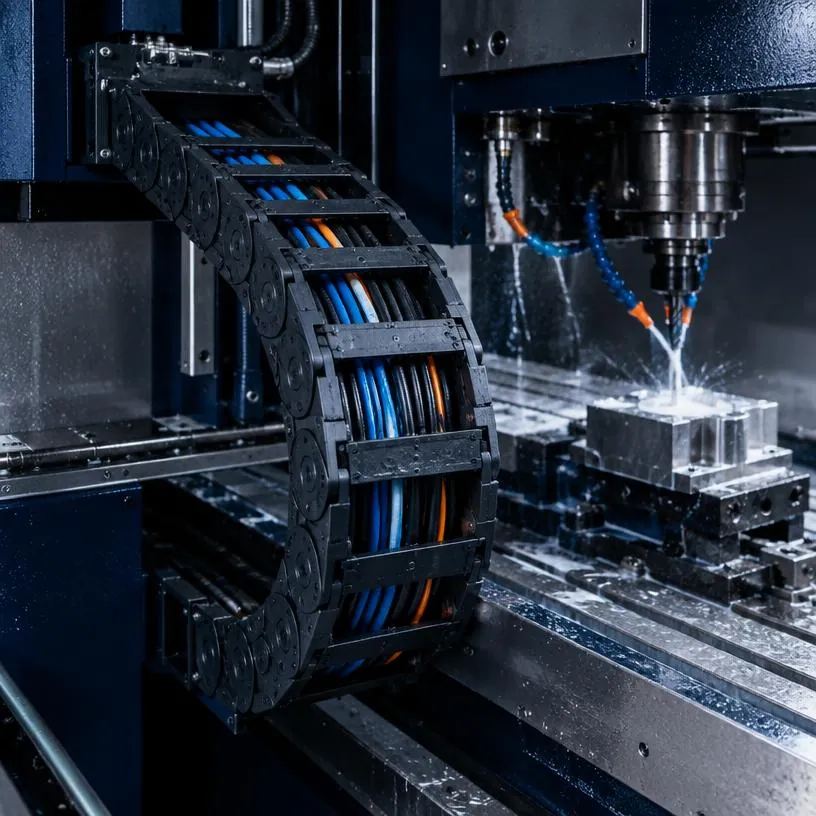
When do you choose a steel cable carrier?
Steel carriers, such as the S/SX and LS/LSX series, come into their own when plastic can no longer cope:
- Heavy cable packages with thick power cables and hydraulic hoses
- Long self-supporting lengths, where a plastic carrier with the same package would sag too much
- Heat and hot chips, for example in sawing, cutting and the steel industry
- Outdoors, offshore and salt: there you choose the stainless SX version
- Heavy mechanical loads in cranes, ports, rolling mills and mining
Against hot chips, an enclosed cable carrier such as the S/SX Tubes offers extra protection, because the cables are fully covered. For radiant heat, combine the carrier with heat protection around the cables.
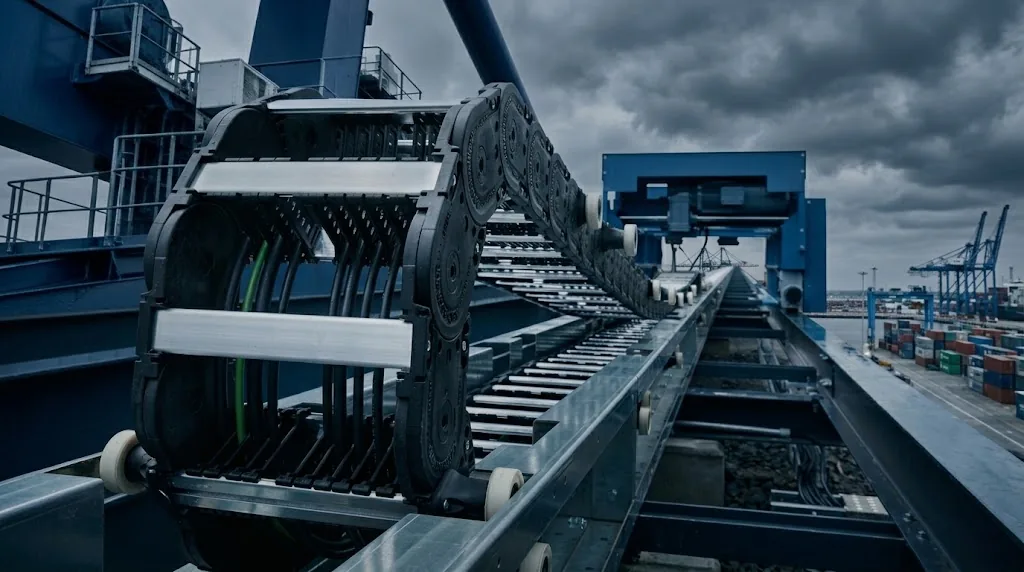
Steel and plastic cable carriers compared
| Property | Plastic | Steel |
|---|---|---|
| Weight | Low | High |
| Noise | Quiet, damped series available | Louder |
| Self-supporting length with a heavy package | Limited | Large |
| Heat and hot chips | Limited resistance | Good resistance |
| Corrosion | None | Galvanised or stainless (SX) |
| Sizes | Fixed dimensions per type, many series | Great freedom in width and layout |
| Price | Economical | Higher |
A more detailed comparison per property is in compare plastic or steel.
Is a long travel length a reason for steel?
Not automatically. On long travel lengths the upper run of the carrier rests on the lower run and glides in a guide channel. That is exactly where plastic carriers are strong. According to the series data, the M series reaches travel lengths of up to 350 m and the TKHP up to 1500 m. In our data the steel S/SX is listed with a travel length of up to 24.9 m.
What steel does do better is carry a heavy package over a long length unsupported, without the carrier collapsing onto itself. So it is about the combination of self-supporting length and additional load, not the travel length alone. The difference between the two installations is explained in self-supporting or gliding.
Don't know the weight of your package yet? Start with a cable list with diameter and weight per metre. How to lay out the package and determine the additional load is explained in laying out a cable carrier with dividers. Calculate the required inner dimensions with calculate fill level.
How to choose in four steps
- (01)Start with plastic. Only move to steel if travel length, weight or environment do not allow it.
- (02)Check the environment: hot chips, radiant heat, outdoors or salt. Chips alone call for an enclosed version; heat and heavy loads call for steel.
- (03)Make a cable list with diameter, weight per metre and minimum bending radius. With it you determine inner dimensions, radius and additional load.
- (04)Calculate the installation: self-supporting or gliding, with the travel length, speed and fixed point.
In the cable carrier configurator you specify the material in the first step. If you start with the configurator for steel cable carriers or the configurator for plastic cable carriers, that choice is already filled in. If you are unsure, choose no preference and let the configurator show the best matching types.
Calculate it yourselfCable carrier configuratorCalculate, select and assemble a cable carrierOpen the cable carrier configuratorWe check your calculation free of charge. When in doubt, for example with a long travel length and a heavy package, we calculate both versions for you. Often a heavier plastic series or a gliding installation turns out more economical than steel. You can also request a quote directly.
Frequently asked questions
Is a steel cable carrier stronger than a plastic one?
A steel carrier can carry heavier packages over longer self-supporting lengths. But for many applications a heavy plastic series is more than sufficient, and it is lighter and quieter.
Can a plastic cable carrier withstand hot chips?
To a limited extent. Ordinary chips can be kept out with an enclosed plastic carrier. With hot chips and high temperatures, a steel carrier, if necessary as an enclosed cable carrier, is the safer choice.
What is the difference between S and SX?
S is galvanised steel, SX is stainless steel. Use SX outdoors, offshore, in the food industry or wherever cleaning agents are used.
Is a steel cable carrier more expensive?
Usually, in purchase price. Over the whole service life it depends on the application: in a harsh environment steel can work out cheaper, in a clean machine plastic is almost always more economical.
Can I replace a plastic cable carrier with a steel one?
You can, but the steel carrier is heavier and has different dimensions and end connectors. Recalculate the drive, the bending radius and the installation space before you switch.
Next step
Calculate it yourself or browse the range. We check your result free of charge.
Series on this topic
Question about this topic?
Ask Joep directly
RMO Specialist at Wisman Techniek