Short answer
You need a shielded cable for anything that emits interference or is sensitive to it: motor and servo cables on a frequency inverter, encoder cables, data and bus. In the cable carrier, separate power and signal with a separator and connect the shield to earth over its full circumference.
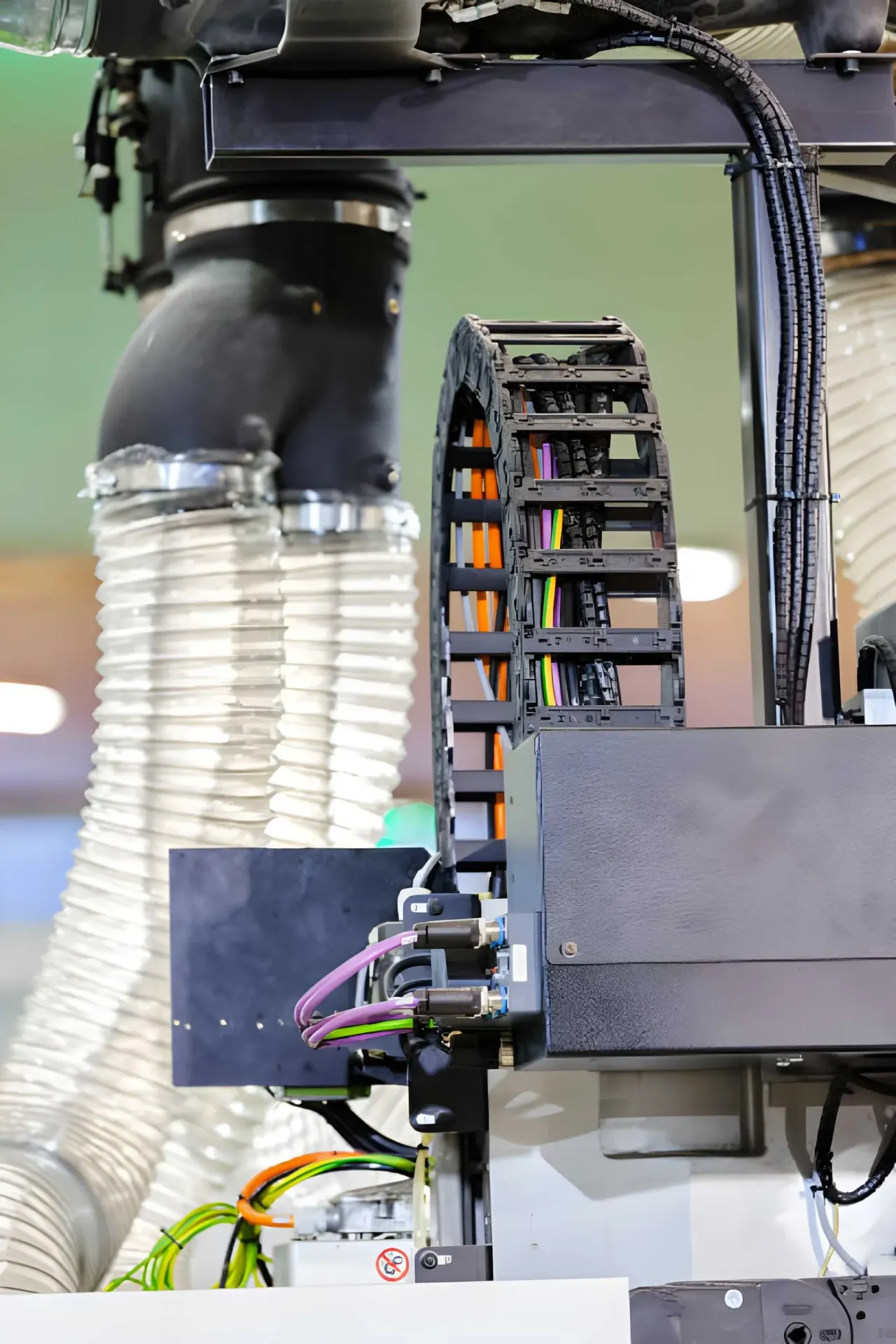
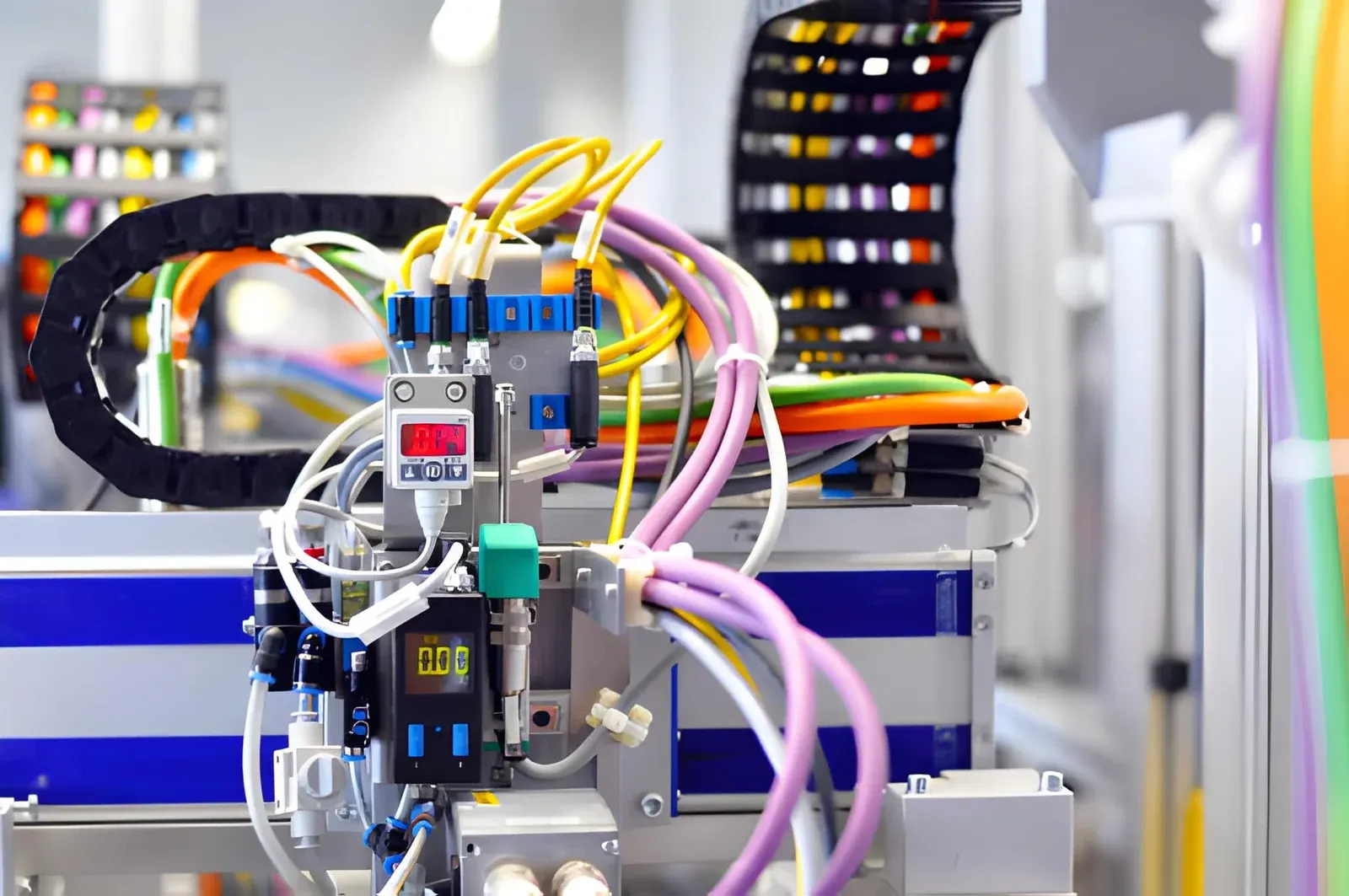
In a cable carrier you use a shielded cable for every cable that emits interference or is sensitive to it. These are mainly the motor and servo cables on a frequency inverter, and the encoder, data and bus cables next to them. In a carrier these cables lie right next to each other over the whole travel length. Without shielding and a good layout, a signal cable picks up the interference from the motor cable, resulting in erratic positions, error messages and machines that stop for no obvious reason.
Why does interference occur in a cable carrier?
A frequency inverter or servo amplifier drives a motor with rapidly switching voltage. This causes high-frequency interference on the motor cable. That cable acts as an antenna: it radiates the interference to everything nearby.
In a cable carrier, "nearby" is literal. Cables lie next to each other for metres, sometimes touching. An encoder cable or bus cable running alongside picks up the interference. The signal is distorted and the control reads incorrect values.
You often recognise interference by:
- Faults that only occur when the motor runs or accelerates
- Position errors or an axis that occasionally misses a step
- Bus faults or communication that drops out and comes back by itself
- Problems that disappear when you lay a cable separately for a moment
If it looks like interference but keeps recurring at the same spot in the travel, it may also be cable breakage. Then read cable breakage in the cable carrier.
Which cables need to be shielded?
Check for each cable whether it emits interference or is sensitive to it. This is the rule of thumb:
| Cable | Shielded? | Why |
|---|---|---|
| Motor cable on a frequency inverter | Ja | Emits interference |
| Servo cable | Ja | Emits interference, often lies next to the encoder cable |
| Encoder and resolver cable | Ja | Sensitive to interference |
| Analogue measurement signals | Ja | Sensitive to interference |
| BUS and network cables | Ja | Sensitive, and prescribed by the bus system |
| Motor cable directly on the mains | Usually not | No rapidly switching voltage |
| Sensors, valves and push buttons | Usually not | Simple on/off signals |
| Fibre optic | No | Immune to electromagnetic interference |
If in doubt, check the installation instructions of the inverter, the encoder or the bus system. They often specify exactly which cable you must use.
What do C and CD mean for TRAXLINE cables?
With the TRAXLINE cables from Tsubaki Kabelschlepp, the shielding is in the name. C stands for a shielded cable. CD usually stands for double shielded. You can see the exact shielding on the series page of the cable; for example, the PROFINET 700 CD is listed in the data as shielded.
Shielded versions are available in all types:
- Control cables: CONTROL 200 C, 400 C, 700 C and 1000 C
- Power cables: POWER 400 C, POWER 700 C, POWER 1000 C TPE and POWER ONE 700 C and 1000 C
- Data cables: DATA 400 C, DATA 700 TPi C and the double-shielded DATA 700 TPi CD
- BUS and network cables: including PROFIBUS 700 C, CAN-BUS 700 C, CAT.5E and CAT.6 700 CD
- System cables: SYSTEM S 700 C and the double-shielded SYSTEM M 700 C, with power and signal in one jacket
For a servo drive you therefore end up with a shielded power cable such as the POWER 700 C 1kV and a twisted-pair data cable such as the DATA 700 TPi C. In the Cable finder you set shielding as a filter and immediately see which series are available.
Calculate it yourselfCable finderThe right flexible cable for your cable carrierOpen the cable finderHow does shielding change the dimensions of your carrier?
A shield is an extra layer around the cores, so the cable gets thicker. An example from the TRAXLINE data: the CONTROL 700 600V 7G1 is 9.5 mm, the same cable as CONTROL 700 C 600V 7G1 is 11.6 mm. For the POWER 700 1kV 4G1.5 it goes from 8.4 to 10.5 mm.
This carries through to the carrier. For the shielded CONTROL 700 C 7G1 of 11.6 mm, the inner height becomes at least 11.6 × 1.1 = 12.8 mm, so 13 mm. The bending radius at least 11.6 × 7.5 = 87 mm, generously 11.6 × 10 = 116 mm. So always calculate with the diameter of the shielded version. How to do this for the whole carrier is explained in determining the right bending radius.
How do you separate power and signal in the cable carrier?
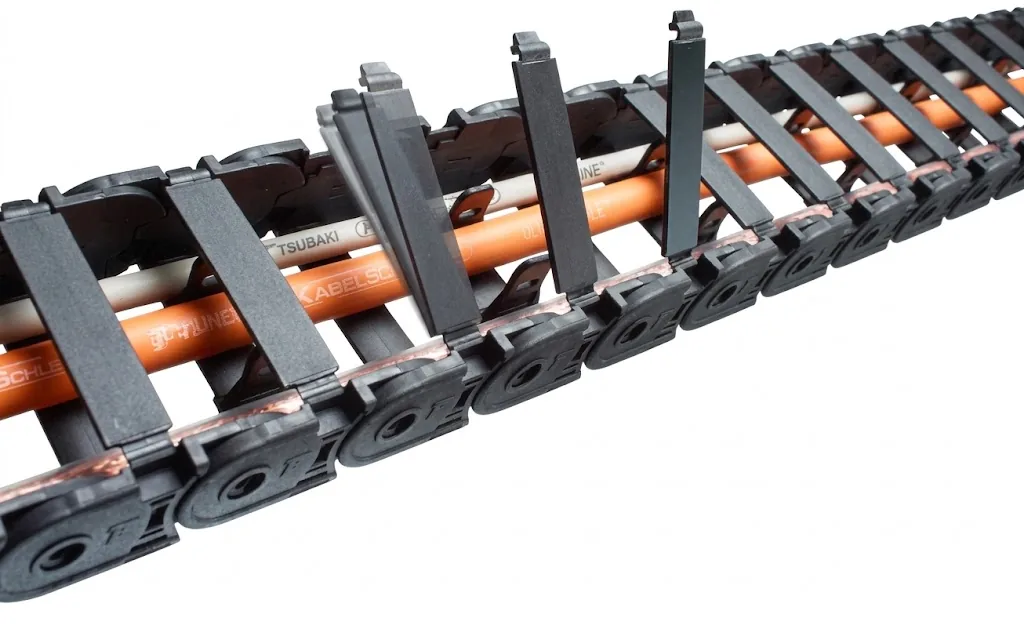
Shielding is the first step, distance the second. Even a shielded motor cable is best not laid against an encoder cable. A separator in the carrier gives each group its own compartment.
- (01)Group your cables: power (motor, servo, supply), signal (encoder, data, bus) and other (sensors, hoses).
- (02)Give each group its own compartment with a separator in between.
- (03)Put heavy cables on the outside: the thick power cables at the sides, light signal cables in the middle. This also keeps the carrier balanced.
- (04)Keep hoses separate from the cables, with 20% clearance instead of 10%.
- (05)Check the layout to scale before you order.
How separators and shelves work and which dimensions we use is explained in dividing the cable carrier with separators. In ChainLogic you draw the layout in the cross-section, with the fill level per compartment and a PDF drawing with parts list.
Calculate it yourselfChainLogicLay out cables, hoses and dividers in the cross-sectionOpen ChainLogicHow do you connect the shield properly?
A shield only works if it is properly earthed. A braid connected to earth by a thin wire, or not connected at all, does little against high-frequency interference. The goal is a low-impedance connection over the full circumference of the braid.
- At the cabinet: expose the shield and clamp it with an EMC clamp onto an earth bar or DIN rail. The clamp presses the braid against a conductive surface over its full circumference. Most EMC clamps also provide strain relief via cable ties.
- Preventing pull on the connection: secure the cable before it reaches the terminal strip, with strain relief. This keeps the movement from the carrier off the connection.
- At the carrier: secure the cable firmly at the fixed point and at the driver. That is where cables break most often, the shield included.
- Follow the instructions of the inverter, motor and encoder on where the shield must be earthed.
How to get cables neatly and sealed into the cabinet is explained in cables into the cabinet.
Is fibre optic an alternative to a shielded cable?
For data, yes. A fibre optic cable transmits light instead of current and is therefore immune to electromagnetic interference. It does not need shielding and can lie right next to a motor cable. The FOC 700 has a PUR jacket and, according to the manufacturer, is suitable for up to 7 million motion cycles and a travel length of up to 500 m.
Fibre optic is particularly interesting for long travel lengths and in environments with a lot of interference, such as next to large drives. For power, and for encoders with a copper connection, a shielded copper cable is still needed.
Shielded cables supplied complete in the carrier
Want to be sure the layout, shielding and strain relief are right? We can supply the carrier complete: cut to length, filled with your cables and with the end connectors fitted. In the Cable carrier configurator, choose your shielded TRAXLINE cables directly in the Cable package step. Already know which cables you need? Add them to your request list; you will hear stock and price within 1 working day. Unsure about the right cables? Send your cable list with a quotation request.
Frequently asked questions
When do I need a shielded cable?
For cables that emit interference, such as motor and servo cables on a frequency inverter, and for cables that are sensitive to it, such as encoder, data, bus and analogue measurement cables.
Does a motor cable on a frequency inverter need to be shielded?
Yes. The inverter drives the motor with rapidly switching voltage, so the motor cable radiates interference. A shielded cable with a properly earthed shield keeps that interference inside the cable.
What does CD mean in the name of a TRAXLINE cable?
C stands for shielded, CD usually for double shielded. The exact shielding is on the series page of the cable.
Can power and signal cables share one cable carrier?
Yes, that is very common. Use shielded cables where needed and give power and signal each their own compartment with a separator.
Is a shielded cable thicker?
Yes, the shield is an extra layer. The CONTROL 700 600V 7G1 is 9.5 mm, the shielded CONTROL 700 C 600V 7G1 is 11.6 mm. So calculate the inner height and bending radius of the carrier with the shielded dimension.
Is fibre optic immune to interference?
Yes. Fibre optic transmits light, not current, and is therefore immune to electromagnetic interference. For power and copper encoder connections, a shielded cable is still needed.
Next step
Calculate it yourself or browse the range. We check your result free of charge.
Series on this topic
Question about this topic?
Ask Bas directly
Cable Carriers Specialist at Wisman Techniek