Short answer
Over a long travel length a cable carrier can no longer support itself. The upper run then rests on the lower run and glides in a guide channel, with the fixed point in the middle. For tens to hundreds of metres choose a gliding series such as UNIFLEX Advanced or M, and for very long travel lengths the TKHP.

A cable carrier for a long travel length almost always runs gliding: the upper run rests on the lower run and glides in a guide channel. In our data self-supporting stops at no more than 17.8 m travel, gliding goes up to hundreds of metres and with the TKHP up to 1500 m. For a crane, a gantry or a storage system with a long stroke you therefore choose a series designed to glide, with a channel, a well-aligned driver and cables that can handle the distance.
Why can't a cable carrier be self-supporting indefinitely?
In a self-supporting arrangement the upper run hangs freely above the lower run. The carrier bears its own weight and that of the cables. The longer the unsupported length, the more the carrier sags. At some point the upper run touches the lower run. The carrier then rattles, the hinges wear and it can break.
The limit varies by type and depends on the weight of the cable package. For plastic carriers the maximum self-supporting travel length in our data goes up to 10.8 m (M1300). Heavy steel types reach 17.8 m. With a heavy package the limit is lower.
If the travel length gets longer, you have three options: a heavier type, a carrier that you support, or a gliding arrangement. For really long travel lengths gliding is the normal choice. The trade-off between the two is explained in self-supporting or gliding.
How does a gliding cable carrier work in a guide channel?
With a gliding cable carrier the fixed point is in the middle of the travel. The lower run lies in the channel, the upper run slides over it and follows the driver. Because the fixed point is in the middle, the carrier is roughly half as long as the travel length, plus the bend.
The channel keeps the carrier in place sideways. Without a channel a gliding carrier moves out of line and runs off itself. Not every series can glide. You need a series with glide shoes or a profile that is suitable for sliding on itself.
When gliding, the permitted speed and acceleration are lower than when self-supporting. You can see this in the table below. On a long travel length, speed is therefore just as decisive as length.
Which cable carrier is suitable for a long stroke?
These are the manufacturer's data for a number of types in our range. The values are maximums per arrangement.
| Type | Self-supporting: travel | Self-supporting: speed | Gliding: travel | Gliding: speed |
|---|---|---|---|---|
| UNIFLEX Advanced UA1555 | 6,3 m | 9 m/s | 125 m | 3 m/s |
| UNIFLEX Advanced UA1775 | 6,8 m | 10 m/s | 300 m | 3 m/s |
| M1300 | 10,8 m | 10 m/s | 350 m | 8 m/s |
| K0900 | 8,4 m | 8 m/s | 260 m | 2 m/s |
| S/SX1250 (steel) | 13,5 m | 2,5 m/s | 200 m | 1 m/s |
| TKHP85-R | no data | no data | 1200 m | 5 m/s |
| TKHP90-R | no data | no data | 1500 m | 10 m/s |
For travel lengths up to a few hundred metres, start with the UNIFLEX Advanced. The UA1775 glides up to 300 m. If it needs to be faster or go a little further, look at the M series. The K0900 is a robust alternative at low speeds.
When do you choose the TKHP for a crane or gantry?
The TKHP is made for long travel. In our data the TKHP85-R glides up to 1200 m at 5 m/s and the TKHP90-R up to 1500 m at 10 m/s, both with an acceleration of up to 50 m/s². There are no data for self-supporting use; this series is designed to glide.
You choose the TKHP when the travel length goes beyond the range of the other gliding series, or when you need a high speed over a long distance. Think of gantry cranes, container cranes, ports and large storage systems. According to our data the TKHP is also suitable for outdoor use, dirty environments, heavy duty and marine applications.
How long is a cable carrier on a long travel length?
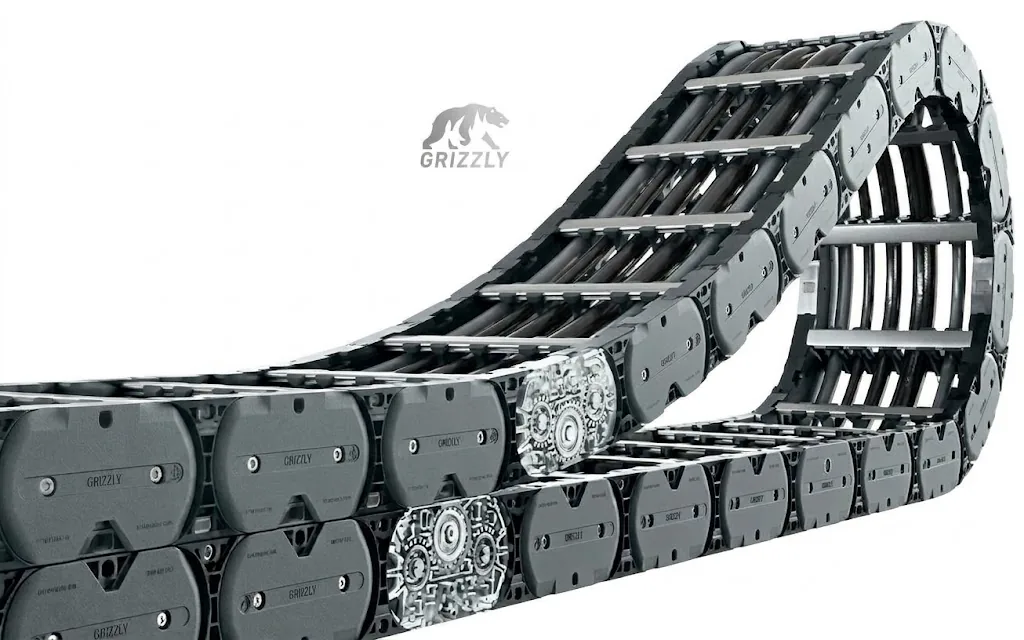
With the fixed point in the middle, the length is half the travel length plus the bend (π × radius) plus two links. Then you round up to whole links.
Example 1: 100 m travel, 3 m/s. A UA1775 with radius 190 mm and pitch 77.5 mm. The length is 50,000 + π × 190 + 2 × 77.5 = 50,000 + 597 + 155 = 50,752 mm. In whole links that becomes 655 links, so 50,762.5 mm.
Example 2: 400 m travel, 6 m/s. Here the UA1775 is ruled out on travel length and speed. A TKHP90-R with radius 360 mm and pitch 90 mm gives 200,000 + π × 360 + 2 × 90 = 200,000 + 1,131 + 180 = 201,311 mm. Rounded up that is 2,237 links, so 201,330 mm.
Check your own situation with calculating the length of your cable carrier.
Calculate it yourselfCalculate cable carrier lengthLength and number of links from travel length and radiusCalculate itWhat else do you need for a gliding arrangement?
A gliding carrier runs only as well as the system around it. These parts belong with it:
- (01)Guide channel: in aluminium, steel or stainless steel, matching the outer width of the carrier. Too much clearance lets the carrier swing, too little makes it jam.
- (02)Fixed point in the middle: this keeps the carrier as short as possible and the tensile force at its lowest.
- (03)Driver in line: centred above the channel and at the right height. A misaligned driver pulls the carrier out of the channel.
- (04)Straight, continuous channel: joints and differences in height make the carrier catch. Align the channel over its full length.
- (05)Strain relief: at the fixed point and the driver, so the cables don't pull on their connections.
If an existing carrier is already running out of the channel, see the troubleshooting guide for a cable carrier running out of the channel. We also supply carrier, guide channel, support and cables as one system, including installation.
Which cables do you use on a long travel length?
On a long travel length the cables don't just bend often, they also lie on top of each other for a long distance and slide along. So choose a cable that is made for the distance. For the TRAXLINE cables by Tsubaki Kabelschlepp the manufacturer specifies a maximum travel length per class:
- Class 400: travel up to 100 m, PVC jacket
- Class 700: travel up to 500 m, PUR jacket, up to 7 million movement cycles
- Class 1000: travel up to 1000 m, TPE jacket, up to 10 million movement cycles
For most long travel lengths you choose class 700. If you go beyond 500 m, you come to class 1000. On cranes and heavy installations, high-voltage cables often run along as well. All classes and properties are listed in which cables for a cable carrier. The Cable Finder finds the lightest class that can handle your travel length and number of movements.
For the inner dimensions, allow 10% clearance for cables and 20% for hoses. Separate heavy power cables and light signal cables with separators, so they don't damage each other.
Having your long travel length calculated
A long travel length calls for several choices at once: series, radius, channel, cable class and the position of the fixed point. In the Cable Carrier Configurator you start directly with a gliding arrangement. The configurator checks travel length, speed and acceleration per type and flags it if no guide channel has been selected. A specialist then checks your configuration free of charge. If you have a drawing of the crane or gantry, send it with a quote request.
Calculate it yourselfCable carrier configuratorCalculate, select and assemble a cable carrierOpen the cable carrier configuratorFrequently asked questions
From what travel length does a cable carrier have to glide?
That depends on the type and the weight of the package. For plastic carriers the self-supporting limit in our data is at most 10.8 m, for steel carriers 17.8 m. Above that you choose a gliding arrangement.
How long can a gliding cable carrier be?
The UNIFLEX Advanced UA1775 glides up to 300 m travel, the M1300 up to 350 m. The TKHP goes up to 1200 m (TKHP85-R) and 1500 m (TKHP90-R).
Does a gliding cable carrier always need a channel?
In practice, yes. The guide channel keeps the gliding run in place. Without a channel the carrier moves out sideways and runs off itself.
Where is the fixed point on a long travel length?
Preferably in the middle of the travel. The carrier is then roughly half as long as the travel length plus the bend, and the tensile force stays as low as possible.
Which cable class do I choose for a crane?
Look at the travel length. For the TRAXLINE cables, class 700 goes up to 500 m and class 1000 up to 1000 m. Choose the lightest class that can handle your travel length and number of movements.
Next step
Calculate it yourself or browse the range. We check your result free of charge.
Series on this topic
Question about this topic?
Ask Bas directly
Cable Carriers Specialist at Wisman Techniek