Short answer
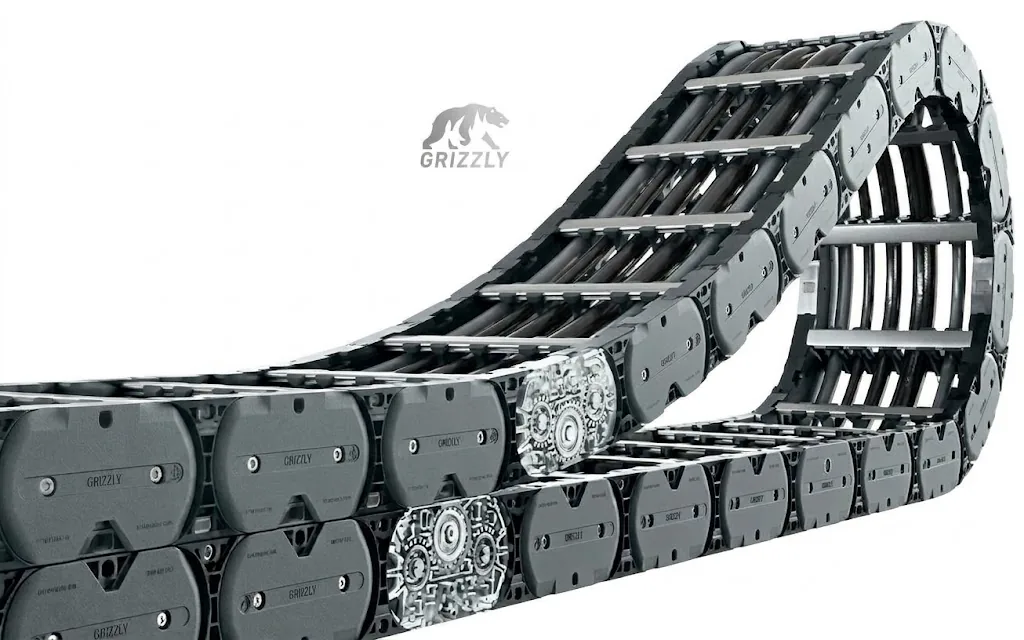
A self-supporting cable carrier hangs without support above its lower run and suits short travel lengths and high speeds. On longer travel lengths the upper run rests on the lower run and glides in a guide channel. Where the limit lies differs per type and depends on the weight of the cable package.

Choose self-supporting if your travel length stays within the self-supporting limit of the type, and gliding if it falls outside it. On a short travel length the carrier supports itself and the upper run hangs freely above the lower run. As the travel length increases, the upper run comes to rest on the lower run and glides in a guide channel. You make this choice first, because it decides which series and types qualify.
What does self-supporting mean for a cable carrier?
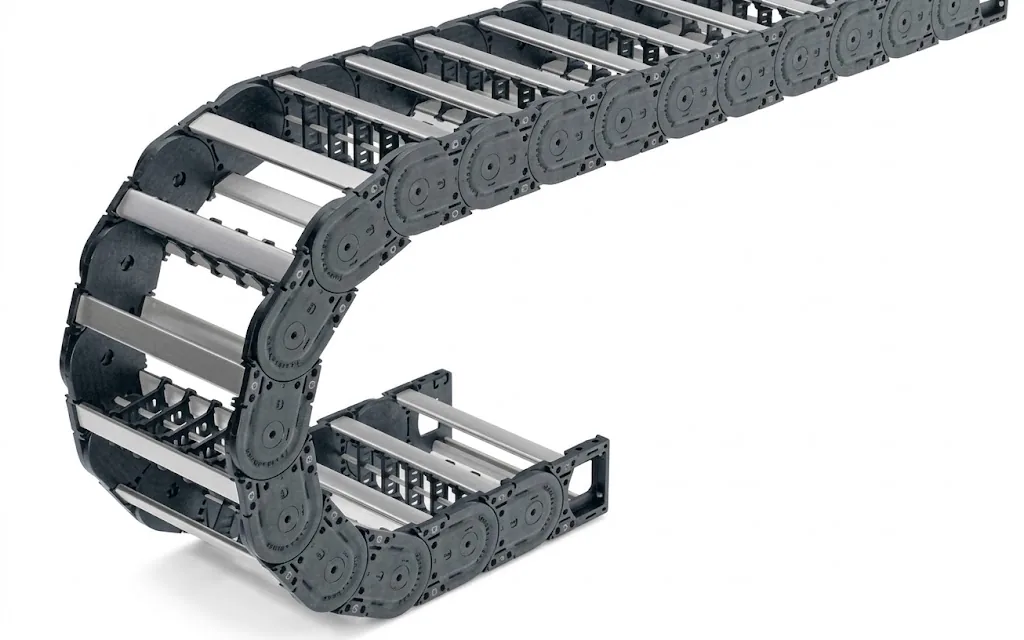
In a self-supporting arrangement the carrier supports itself over its entire length. The fixed point is usually in the middle of the travel and the upper run hangs freely above the lower run. The carrier does not touch itself and needs no channel.
- Suitable for: short to medium travel lengths
- Advantages: high speeds and accelerations, little contact and therefore little wear, simple installation
- Limit: the maximum travel length differs per type and decreases as the cable package gets heavier
A slight sag is normal. If the package gets heavier or the travel longer, the sag increases until the upper run drops onto the lower run. A carrier that is just too long to support itself rattles and wears. You can read more about this in the article on a quiet cable carrier.
What is a gliding cable carrier?
In a gliding arrangement the upper run rests on the lower run and glides over it. The carrier runs in a guide channel that keeps it in place sideways. Without a channel a gliding carrier moves sideways and runs off itself.
- Suitable for: travel lengths from tens to hundreds of metres
- Advantages: much longer travel lengths, also with heavy packages
- Points of attention: lower speeds and accelerations than self-supporting, a channel that is straight and well aligned, sliding surfaces that wear
Not every series is made to glide on itself. For long travel lengths you need a series with glide shoes or a profile suitable for it.
Up to what travel length can a cable carrier be self-supporting?
That is stated per type in the manufacturer's data. Below are a few examples from our range, with the maximum travel length and speed per arrangement.
| Type | Self-supporting: travel | Self-supporting: speed | Gliding: travel | Gliding: speed |
|---|---|---|---|---|
| UNIFLEX Advanced UA1455 | 4,8 m | 10 m/s | 120 m | 2,5 m/s |
| QUANTUM Q080 | 6,4 m | 25 m/s | 80 m | 3 m/s |
| M0950 | 7,4 m | 10 m/s | 260 m | 8 m/s |
| K0900 | 8,4 m | 8 m/s | 260 m | 2 m/s |
| TKHP90-R | no data | no data | 1500 m | 10 m/s |
You notice two things. In our data no type goes further than 17.8 m travel self-supporting, while gliding reaches hundreds of metres. And the permitted speed and acceleration also differ per arrangement. The UNIFLEX Advanced and the M series can do both, the TKHP is made for long gliding travel lengths.
The values in the table are maximums. With a heavy package the self-supporting limit is lower, and close to a limit you are better off calculating with a heavier type.
How do you choose between self-supporting and gliding?
- (01)Collect your data: travel length, speed, acceleration and the weight of the cable package per metre.
- (02)Compare with the type: does the travel length fit within the self-supporting limit, including speed and acceleration?
- (03)If it fits: choose self-supporting. It is the simplest and quietest arrangement.
- (04)Just too long: choose a heavier type with a longer self-supporting travel, or support the carrier.
- (05)Far too long: choose a gliding arrangement with a guide channel.
You do not have to make that comparison by hand. The Cable carrier configurator checks travel length, speed and acceleration per type for both arrangements and rules out types that do not meet them. If you are still exploring, the selection guide on the cable carrier page asks about the length of the movement: up to 5 m is usually self-supporting, above 50 m gliding.
Calculate it yourselfCable carrier configuratorCalculate, select and assemble a cable carrierOpen the cable carrier configuratorWorked example: how long will the cable carrier be?
With the fixed point in the middle, the length of the carrier is half the travel plus the bend (π × radius) plus two links, rounded up to whole links.
Self-supporting, 4 m travel. A UNIFLEX Advanced UA1455 with a radius of 125 mm and a pitch of 45.5 mm. The length is then 2000 + π × 125 + 2 × 45.5 = 2000 + 393 + 91 = 2484 mm. In whole links that becomes 55 links, so 2502.5 mm. The installation height is about 2 × 125 + 36 = 286 mm. The travel of 4 m stays within the 4.8 m self-supporting limit.
Gliding, 60 m travel. An M0950 with a radius of 200 mm and a pitch of 95 mm. The length is 30,000 + π × 200 + 2 × 95 = 30,000 + 628 + 190 = 30,818 mm, rounded to 325 links or 30,875 mm. Self-supporting, this type goes up to 7.4 m, so this carrier glides in a channel.
If you want to recalculate it for your own situation, use calculate the length of your cable carrier. How to determine the radius is explained in calculating a cable carrier in six steps.
Calculate it yourselfCalculate cable carrier lengthLength and number of links from travel length and radiusCalculate itWhat if the travel length is just too long to be self-supporting?
Sometimes the travel length falls just outside the self-supporting limit. Then there are three routes. You choose a heavier type with a longer self-supporting travel, such as the step from M0650 (4.8 m) to M0950 (7.4 m). You support the carrier with a roller or support arm, so the self-supporting length increases without needing a channel. Or you switch to gliding.
Which route is best depends on the space in your machine, the speed and the weight. We are happy to recalculate that with you.
What should you watch for in a gliding arrangement?
A gliding carrier runs only as well as its channel. With malfunctions we keep seeing the same causes:
- Channel does not fit: the channel must match the outer width of the carrier. Too much room lets it sway, too little makes it jam.
- Driver out of line: if the driver is not centred above the channel or is at the wrong height, it pulls the carrier askew.
- Channel not straight or not continuous: joints and height differences make the carrier snag.
- Series not suitable for gliding: without glide shoes or a suitable profile the carrier wears quickly.
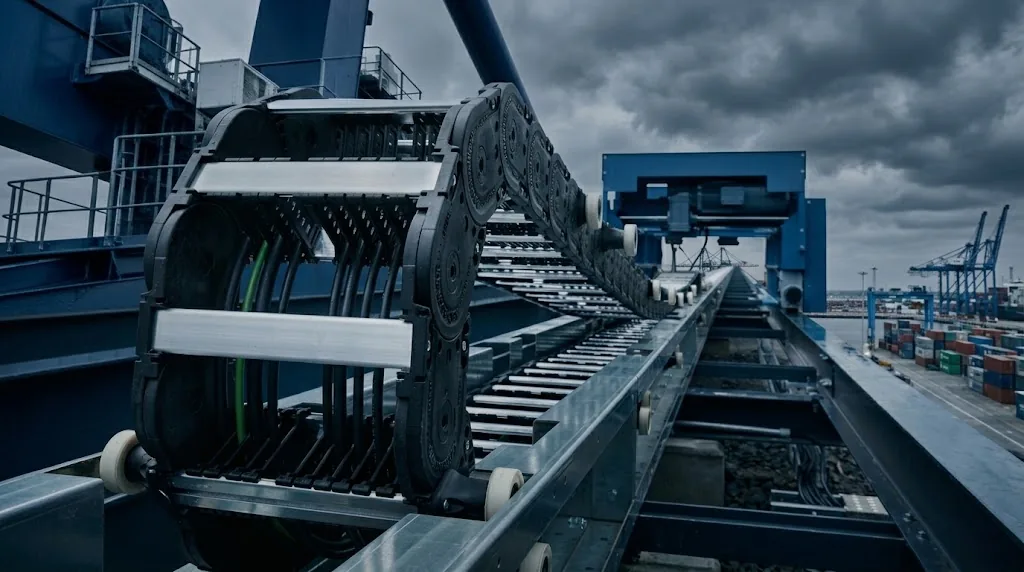
If your carrier already runs out of the channel, check the troubleshooting guide for a cable carrier that runs out of the channel. For gantry cranes, ports and storage systems with long travel lengths, gliding is the normal arrangement. The TKHP is made for long movements, with gliding travel lengths up to 1500 m. Wisman also takes care of assembly and installation of carrier and channel.
Frequently asked questions
Up to what length is a cable carrier self-supporting?
That differs per type and depends on the weight of the cable package. In our data the maximum self-supporting travel ranges from less than 1 m for the smallest types to 17.8 m for heavy steel types. In the configurator you can see per type whether your travel can be self-supporting.
Does a gliding cable carrier always need a guide channel?
In practice, yes. The channel keeps the gliding run in place and prevents the carrier from moving sideways or running off itself.
Is a gliding cable carrier slower than a self-supporting one?
Usually, yes. Per type, the permitted speed and acceleration are lower when gliding than when self-supporting, because the upper run slides over the lower run.
Which cable carrier is suitable for a long travel length?
For long travel lengths you look at series made to glide. The TKHP goes up to 1500 m, the M up to 350 m and the K up to 260 m.
How long is a cable carrier in a gliding arrangement?
With the fixed point in the middle, roughly half the travel plus π × radius plus two links, rounded to whole links. At 60 m travel that is just over 30 m of carrier.
Next step
Calculate it yourself or browse the range. We check your result free of charge.
Series on this topic
Question about this topic?
Ask Joep directly
RMO Specialist at Wisman Techniek