Short answer
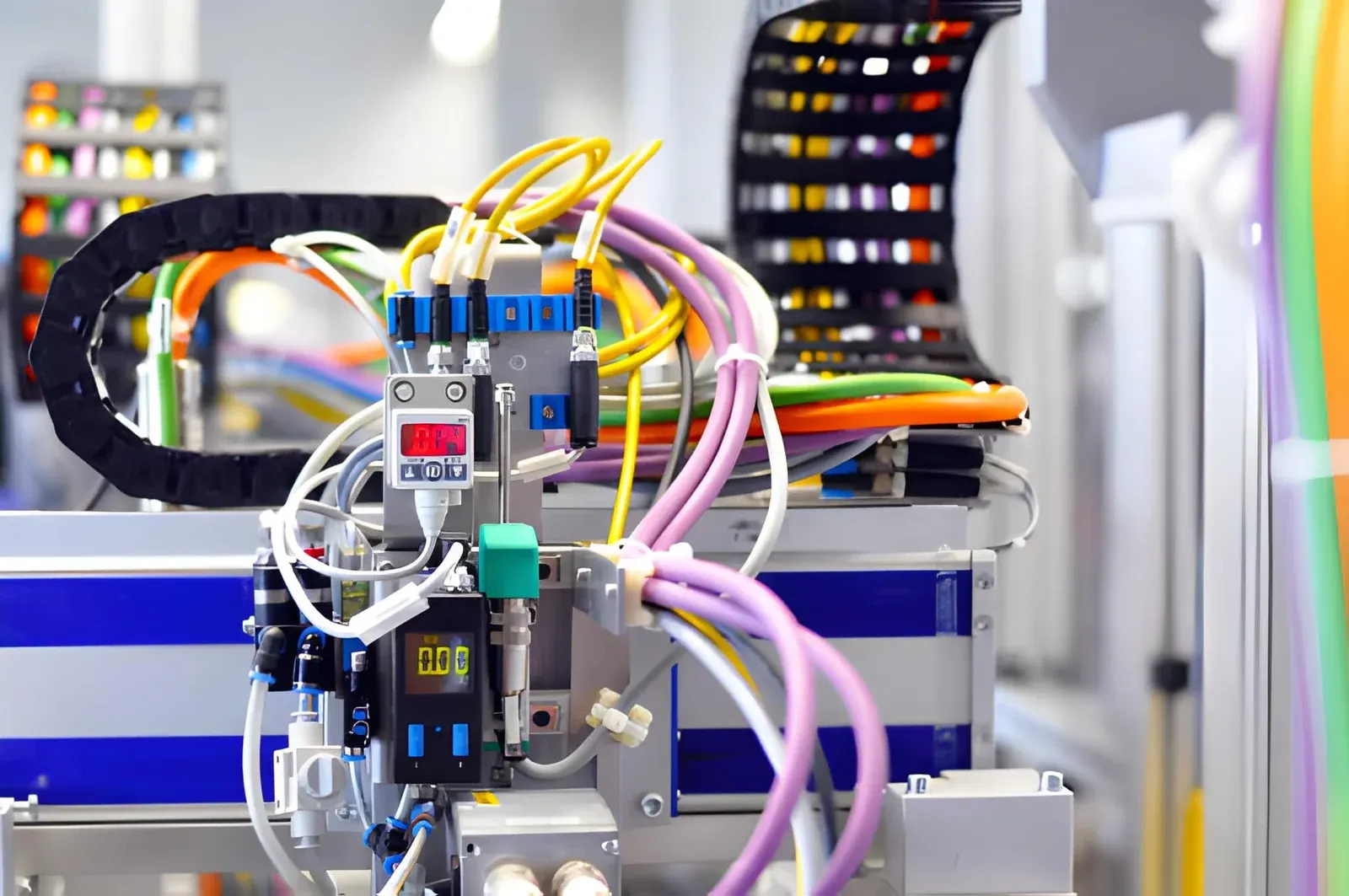
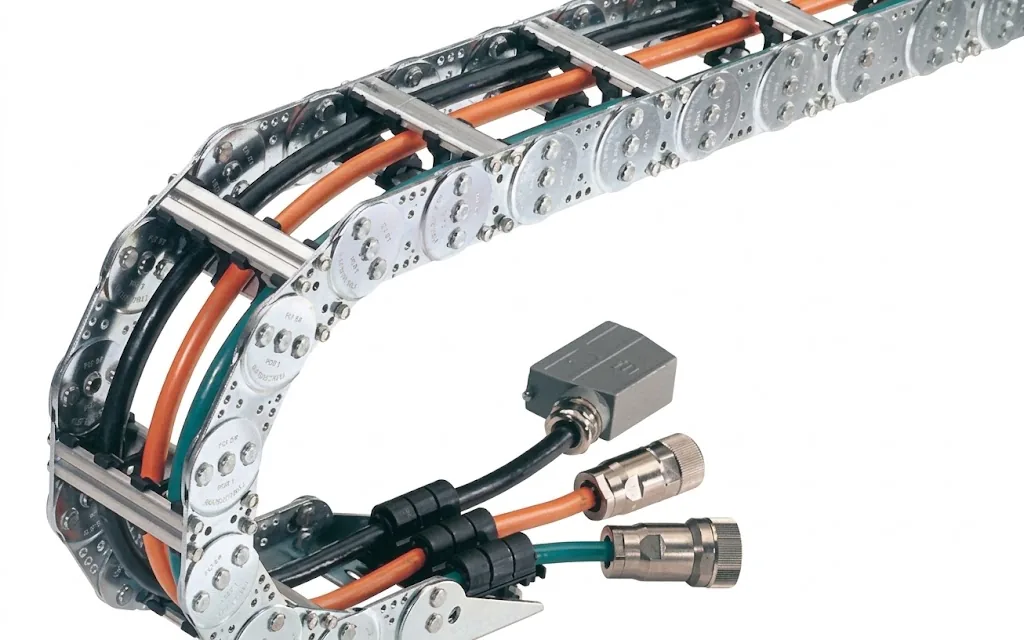
A cable carrier is a flexible chain of links that holds the cables and hoses moving with a machine part. It sets a fixed bend, so cables do not kink, twist or chafe. As a result, cables and hoses last much longer and the machine keeps running.
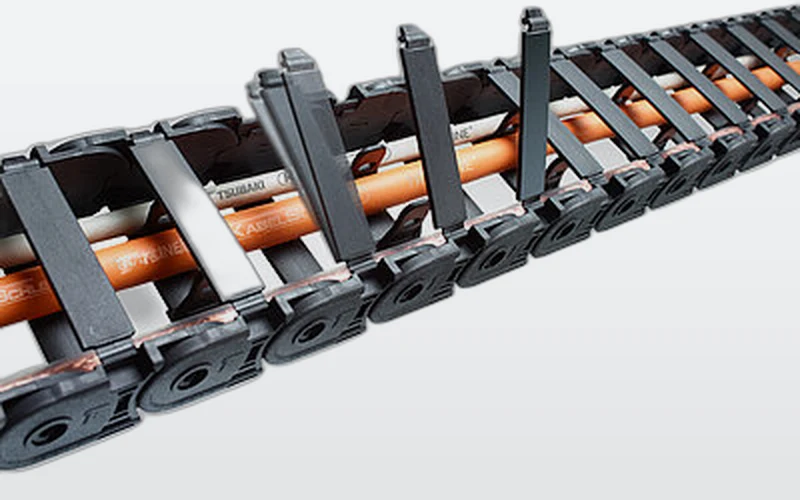
A cable carrier is a chain of hinged links that safely guides cables and hoses along with a moving part of a machine. It sets the bend in which the cables flex and keeps them in place. Without a carrier, a moving cable kinks, twists and chafes, and sooner or later that ends in a break and a machine at a standstill.
In this article you will read how a cable carrier works, what it prevents, where you find it and how to choose the right one. Want to know why the same product is also called an energy chain or drag chain? Read cable carrier, energy chain or drag chain. How the carrier is built up, from link to guide channel, is covered in parts of a cable carrier.
How does a cable carrier work?
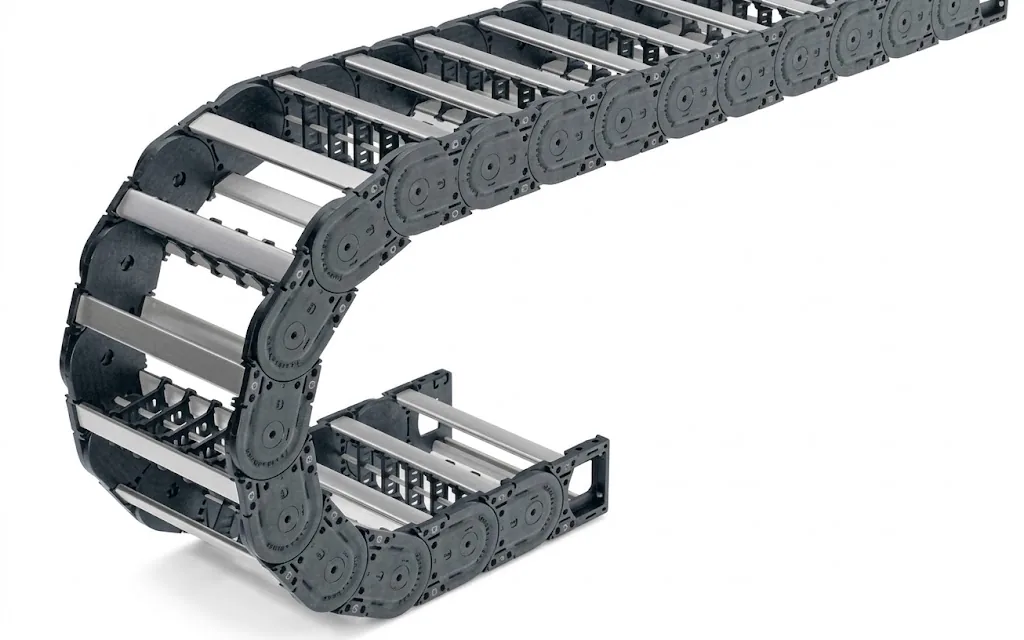
A cable carrier has two ends. One is attached to the fixed point, the stationary part of the machine. The other is attached to the driver on the moving part. When the machine moves, the carrier rolls off and back on, like a track running over itself.
This creates a lower run, an upper run and a bend in between. The bend moves along with the motion but always has the same radius: the bending radius. Because the links cannot bend further than that radius, no cable bends more tightly than it can handle.
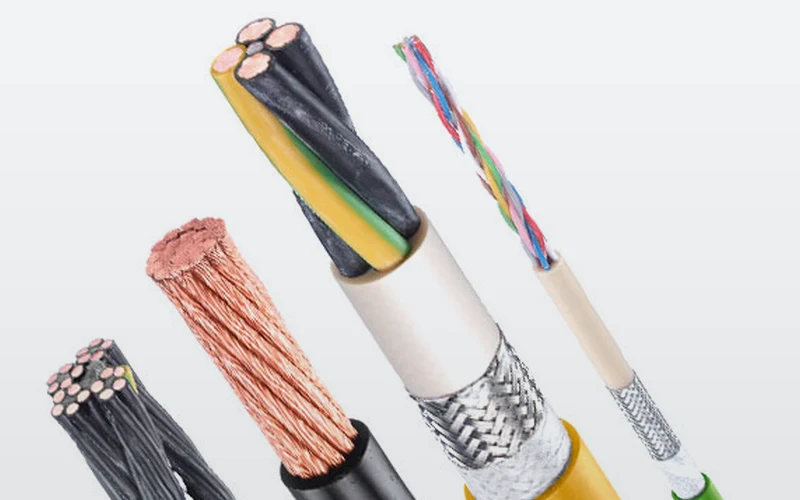
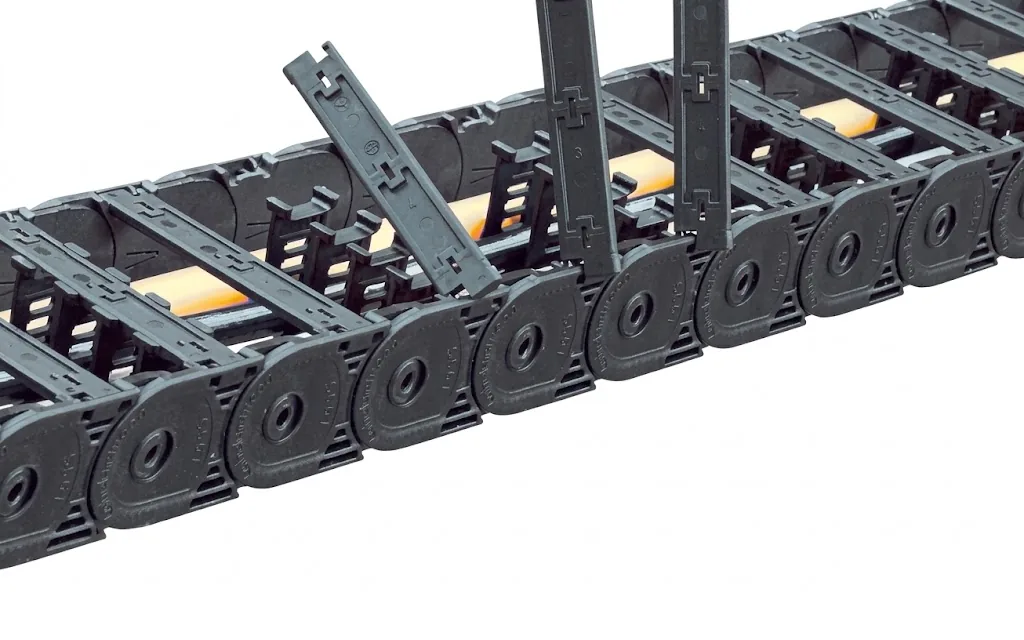
Inside, the cables and hoses lie side by side, often separated by dividers. They lie loose in the carrier and are only fixed at the ends with strain relief. This lets them move slightly in the bend without pulling or compressing.
What does a cable carrier prevent?
A cable that moves freely bends at a different spot and in a different curve every time. The copper strands in the cable then fatigue quickly. A cable carrier removes those causes:
- Cable breakage from bends that are too tight or bending points that keep shifting
- Torsion: cables twisting around their axis and braiding into each other
- Chafing and wear of jackets against each other or against the machine
- Tangles and faults from cables and hoses getting in the way or getting caught
- Unsafe situations from loose cables on the floor or in the work area
If cables in an existing carrier keep failing anyway, the cause is usually the radius, the cable type or the layout. The troubleshooting guide on cable breakage in the cable carrier walks you through the causes.
Where are cable carriers used?
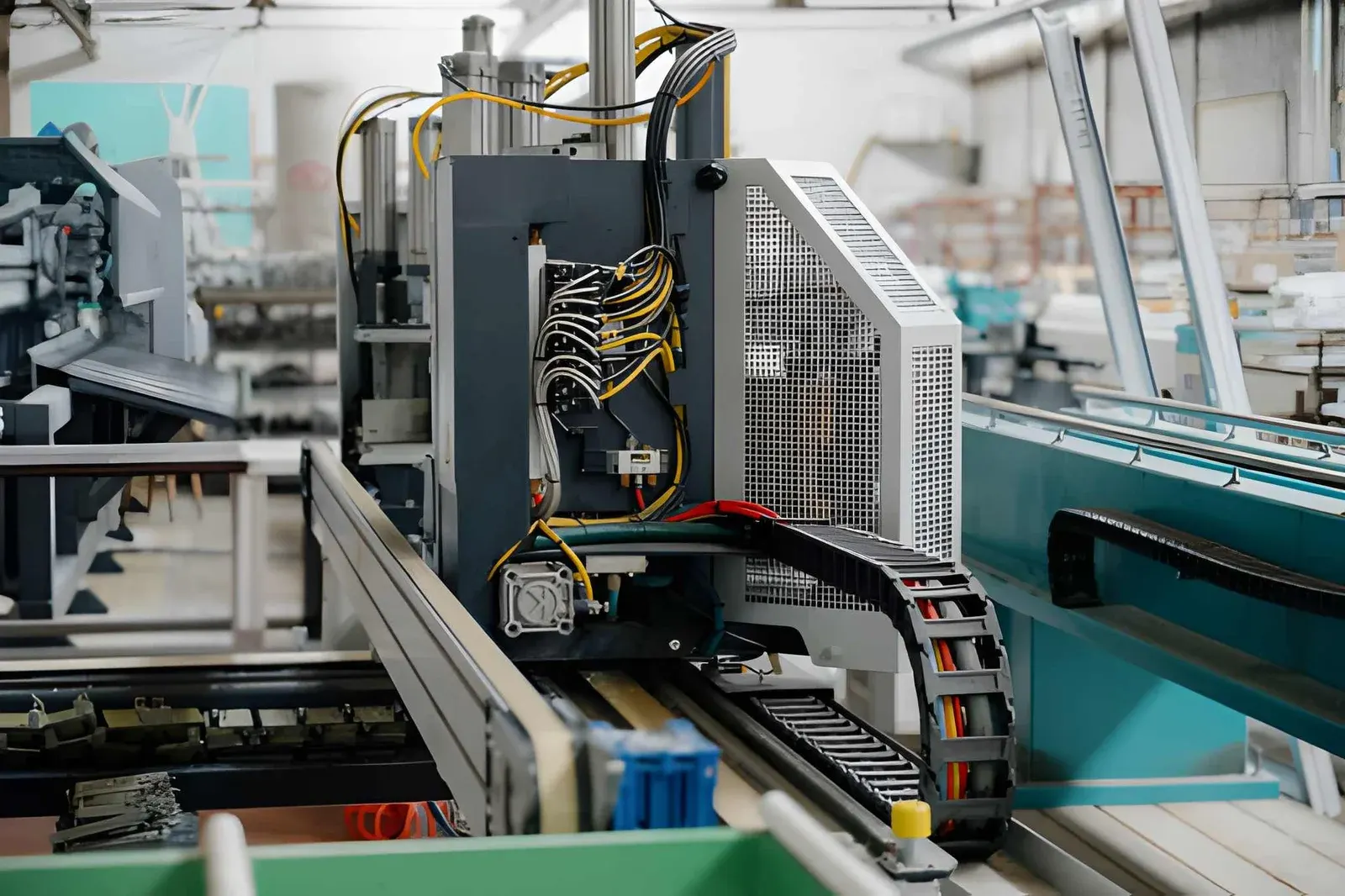
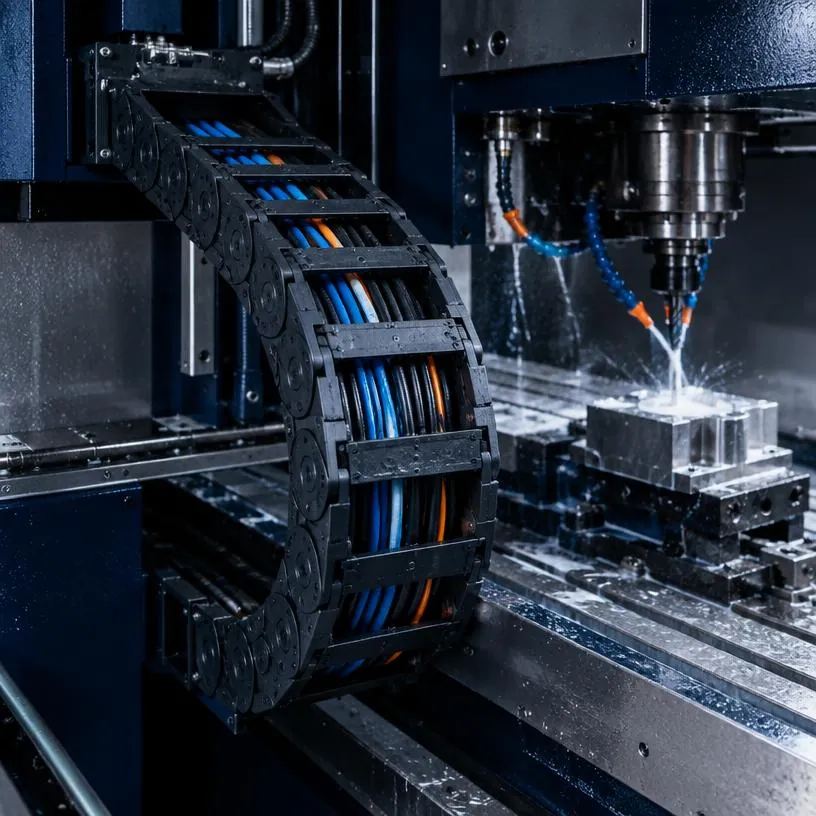
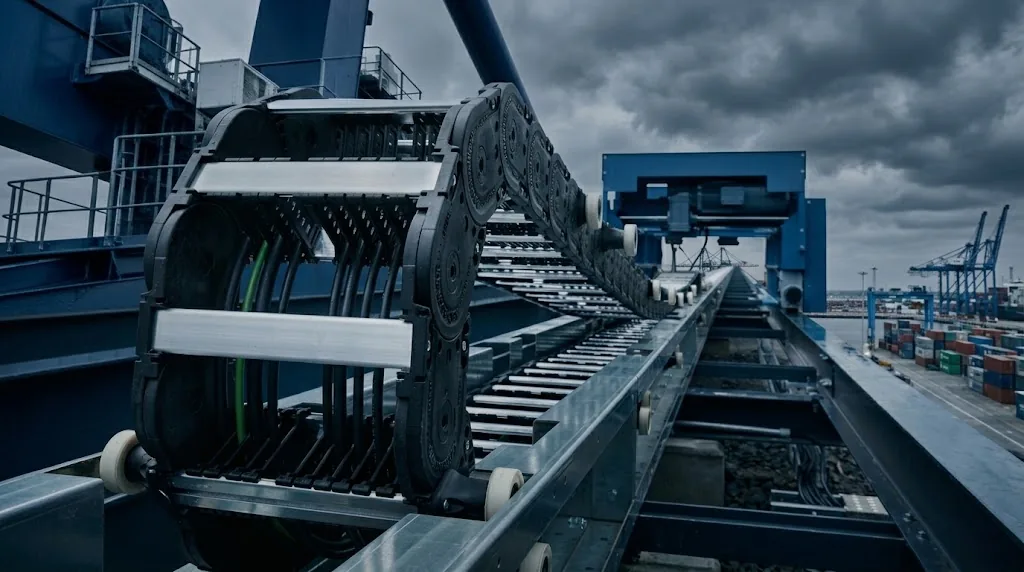
Wherever something moves in a line or an arc and needs power, signals or media to follow: the axes of machining centres, gantry robots, packaging machines, sawing machines, cranes, storage systems, lifts and stage technology. Travel lengths range from a few centimetres in a small automated machine to hundreds of metres on a crane runway.
In machine building it is often about short, fast movements with many cycles. On cranes and in ports it is about long travel lengths, heavy cable packages and wind and weather. That difference determines which type of carrier fits.
What types of cable carriers are there?
All cable carriers work on the same principle, but designs differ widely. The main choices:
| Choice | When |
|---|---|
| Plastic | Most machines: light, quiet, corrosion-free |
| Steel | Heavy cable packages, heat, long unsupported length |
| Open | Laying in and inspecting cables quickly |
| Closed | Keeping chips, dust and dirt out |
| Self-supporting | Short travel, the carrier supports itself |
| Gliding | Long travel, the upper run glides in a channel |
You can read the trade-offs for each choice in plastic or steel, open or closed and unsupported or gliding.
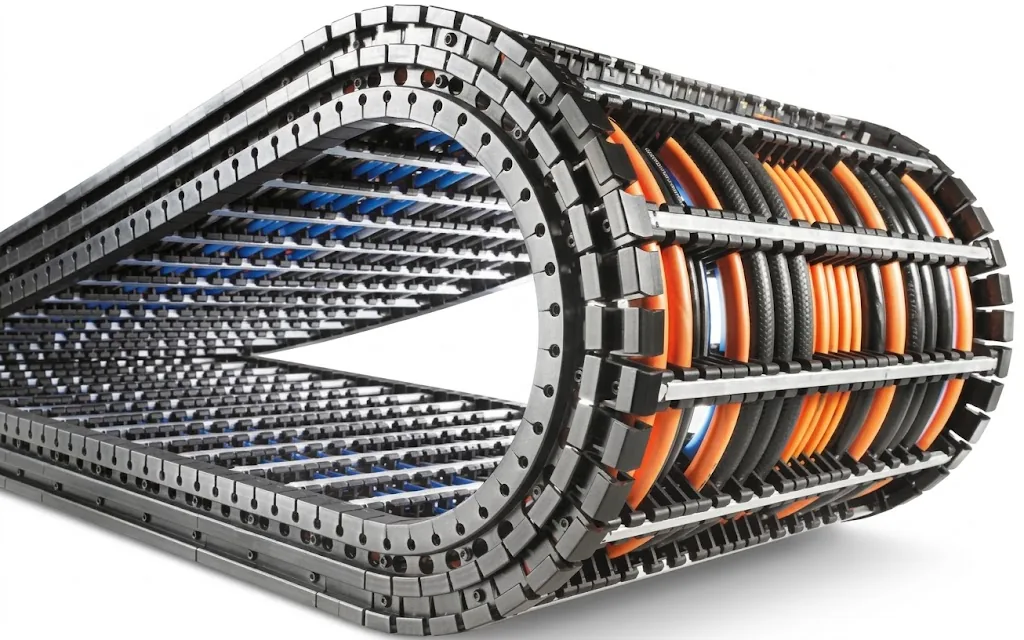
In plastic there are light all-rounders such as the UNIFLEX Advanced, the variable M series with many options and extra quiet series such as QUANTUM®. For heavy work there is the steel S/SX series. You will find all series side by side under cable carriers.
What information do you need to choose a cable carrier?
The choice follows from the application, not from a catalogue. These five details get you a long way:
- (01)Travel and layout: how far does the part move, and is the fixed point in the middle or at the end?
- (02)Speed and acceleration: how fast and how abruptly does the part move?
- (03)Cable package: which cables and hoses go in, with what diameter and what weight?
- (04)Most sensitive cable: what is the minimum bending radius in the data sheet?
- (05)Environment: clean, dusty, with chips, heat or outdoors?
The cable package gives you the inner dimensions, the thickest cable gives you the radius, and travel and speed give you the series. How to read those inner dimensions exactly is explained in cable carrier dimensions explained.
Worked example: from cable package to cable carrier
Say a gantry moves 2 metres back and forth, the fixed point is in the middle of the travel and the thickest cable is 12 mm.
- Inner height: calculate with the effective diameter, cable × 1.10. That is 12 × 1.10 = 13.2 mm, so an inner height of at least 13.2 mm.
- Bending radius: at least 7.5 × the thickest cable, so 12 × 7.5 = 90 mm. If the machine moves a lot, choose generously: 10 × 12 = 120 mm. If the minimum radius in the data sheet is larger, that one applies.
- Length: with the fixed point in the middle, the length is roughly half the travel plus the bend plus two links: 1000 + π × 100 + 2 × pitch. If you choose a carrier with a radius of 100 mm (above the minimum of 90 mm) and a pitch of 50 mm, that is 1000 + 314 + 100 = 1414 mm, rounded up to whole links 1450 mm (29 links).
- Installation height: roughly 2 × radius + the outer height of the carrier.
The width follows from all cables and hoses side by side, with hoses × 1.20. Keep the fill level below 85% to leave room for movement and an extra cable later.
You can check each step separately with calculate bending radius and calculate cable carrier length. In the Cable carrier configurator everything comes together and you see right away which types fit.
Calculate it yourselfCable carrier configuratorCalculate, select and assemble a cable carrierOpen the cable carrier configuratorWhen is a cable carrier not the best solution?
A cable carrier is made for movements in one plane: linear back and forth, or an arc. If a cable package moves in three dimensions, such as over the axes of an industrial robot, a protective hose with holders and a retraction system is often better. That is called a dresspack. You can read the difference in cable carrier or protective hose.
For very short movements with one thin cable, a flexible cable without a carrier can sometimes be enough. As soon as there are more cables, the movement repeats often or the cable drags across a floor or machine, a carrier is the safe choice.
Unsure about the choice, or want your calculation checked? Send your details through the quote request. Wisman checks calculations from the tools free of charge and assembles the carrier to size in Ruurlo.
Frequently asked questions
What is the difference between a cable carrier and an energy chain?
There is no difference. Cable carrier, energy chain, cable chain and drag chain are names for the same product. The differences between carriers lie in series, material and design, not in the name.
How long does a cable carrier need to be?
With the fixed point in the middle, the length is roughly half the travel plus π × the bending radius plus two links, rounded up to whole links. If the fixed point is at the end, calculate with the full travel.
Which cables can go in a cable carrier?
Use cables made for continuous movement, with fine-stranded conductors and a wear-resistant jacket. Ordinary installation cable is not designed for continuous bending and breaks much sooner in a carrier.
How full can a cable carrier be?
Work with a fill level below 85% of the inner cross-section. Between 85 and 90% it is tight; above 90% the carrier is too full and the cables chafe against each other and against the links.
Can you calculate a cable carrier yourself?
Yes. With the travel, the cable package and the thickest cable you can work out the inner dimensions, radius and length. The Cable carrier configurator does this in a few steps and shows which types fit.
Next step
Calculate it yourself or browse the range. We check your result free of charge.
Series on this topic
Question about this topic?
Ask Bas directly
Cable Carriers Specialist at Wisman Techniek